
Loading...

Your recruitment AI just flagged qualified candidates as "high risk." Legal demands an immediate audit. IT points to Data Science. Data Science points back to IT. Meanwhile, your board wants answers about who approved this system in the first place. This scenario plays out across enterprises daily, exposing a fundamental problem: nobody truly owns AI governance.
According to McKinsey research, 66% of directors report having "limited to no knowledge or experience" with AI, yet 88% of organizations now use AI in at least one business function. This gap between adoption and oversight creates chaos among AI governance stakeholders, leaving teams uncertain about roles, responsibilities, and accountability across both enterprise strategy and technical model management.
The ownership vacuum isn't theoretical; it's causing real operational paralysis across enterprises. Multiple departments claim pieces of AI governance, yet none hold complete accountability for ensuring systems are safe, ethical, and compliant.
Privacy teams naturally gravitate toward AI governance because they already manage data protection, GDPR compliance, and consent frameworks. They understand regulatory language and risk assessment. However, they lack expertise in model explainability, algorithmic bias detection, or MLOps monitoring, which are technical components critical for governing AI systems beyond data privacy.
Legal teams focus on contractual language around AI vendor agreements, intellectual property disputes over AI-generated content, and liability frameworks when AI systems cause harm. They draft policies but rarely have visibility into which models are deployed, how they're monitored, or when they drift from acceptable performance parameters.
Security professionals recognize new threats like adversarial attacks, model exfiltration, prompt injection vulnerabilities, and training data poisoning. They implement access controls and monitor for security breaches. Yet they typically don't assess ethical risks, fairness metrics, or business impact of model decisions, or governance concerns that extend beyond cybersecurity.
Tech-forward organizations in SaaS and data-driven industries often have dedicated AI Risk Officers or governance committees. Traditional enterprises, particularly those under 10,000 employees, lack formal AI oversight entirely, relying on ad-hoc responsibility assignments that change project by project.
Forward-thinking organizations are creating Chief AI Officers, Algorithmic Impact Auditors, and AI Governance Committees. These roles are still evolving, with no standardized responsibilities, reporting structures, or authority levels. Research from ModelOp found no clear consensus on who should oversee AI governance, with responsibilities scattered across Chief Data Officers, Chief Analytics Officers, and newly created positions.

Delaying governance decisions doesn't save money; it exposes organizations to cascading risks that compound over time. The financial, legal, and reputational consequences of ungoverned AI are severe.
The EUAI Act imposes fines up to €35 million or 7% of global annual turnover for deploying prohibited AI systems. In the United States, federal agencies introduced 59 AI-related regulations in 2024, more than double the 2023 count. Companies operating across jurisdictions face overlapping compliance requirements, each carrying substantial penalties for violations.
AI systems making discriminatory decisions in hiring, lending, or criminal justice destroy decades of brand trust overnight. Headlines about biased algorithms spark boycotts, shareholder activism, and class-action lawsuits. Recovery costs extend far beyond immediate legal settlements; they include customer acquisition expenses, employee morale impacts, and lost business opportunities.
Questions about who owns AI-generated code, designs, marketing copy, or patents create legal uncertainty. Companies deploying generative AI without clear ownership frameworks face disputes with employees, contractors, customers, and competitors. These conflicts freeze projects, waste legal resources, and create uncertainty around monetization strategies.
When attackers extract proprietary training data or manipulate model weights, they compromise competitive advantages and customer information simultaneously. Model poisoning attacks can subtly bias decisions in the attackers' favor for months before detection. Recovery requires complete model retraining, security audits, and customer notifications, often under regulatory breach disclosure requirements.
Models that drift from acceptable performance cause direct business losses. Credit scoring models that degrade approve bad loans. Inventory optimization models that drift create stockouts or excess inventory. Fraud detection models that drift miss fraudulent transactions or block legitimate customers. Without governance frameworks catching drift early, these failures accumulate until crises force intervention.
AI governance operates on two distinct but interconnected layers. Conflating them creates accountability gaps, while separating them enables clear ownership and effective oversight.
Organizational AI governance establishes enterprise-wide frameworks ensuring AI systems align with business strategy, ethical principles, regulatory requirements, and risk tolerance. It operates at the board and C-suite level, setting policies that cascade through business units and technical teams.
For example, a healthcare organization's governance framework might prohibit AI systems from making final treatment decisions without physician review, require patient consent for AI-assisted diagnosis, and mandate annual fairness audits for all clinical algorithms.
This governance layer defines acceptable AI use cases, establishes oversight committees, creates vendor evaluation criteria, and sets metrics for measuring governance effectiveness. It answers strategic questions like "Which AI initiatives merit investment?" and "What level of risk will we accept for different use cases?"
Automated model governance manages individual AI systems throughout their technical lifecycle, from initial development through deployment, monitoring, retraining, and eventual decommissioning. It implements organizational policies through technical controls, monitoring systems, and operational processes. Core components include model registries tracking all organizational models, automated bias testing before deployment, drift detection triggering retraining workflows, explainability tools generating decision justifications, and audit trails documenting every model change.
MLOps teams automate these governance controls so they scale across hundreds of models without manual oversight for every decision. Model governance ensures systems meet technical standards, maintain acceptable performance, comply with regulations requiring explainability, and escalate issues to organizational governance when technical controls detect problems exceeding preset thresholds.
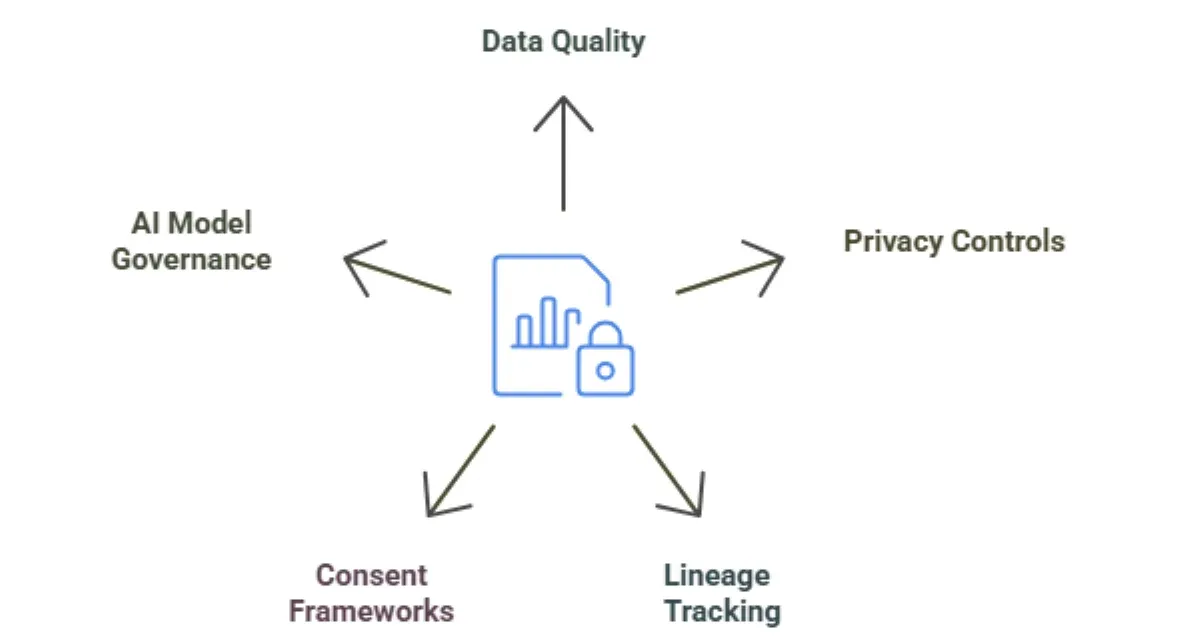
Model governance fails without strong data governance, yet data governance alone doesn't address the unique challenges AI systems introduce. The relationship between these governance domains is foundational but insufficient.
Models trained on incomplete, inaccurate, or outdated data produce unreliable outputs regardless of algorithmic sophistication. Data governance ensures training datasets are clean, complete, representative, and properly labeled. Without this foundation, model governance detects problems downstream rather than preventing them upstream.
GDPR, CCPA, and sector-specific regulations require consent management, data minimization, anonymization, and deletion rights. Data governance implements these controls across all datasets. Model governance extends them by tracking which models were trained on which data, enabling proper responses when individuals exercise privacy rights.
Understanding model behavior requires knowing what data was trained on, how that data was processed, what transformations occurred, and which versions were used. Data governance maintains lineage from source through preprocessing. Model governance links this lineage to model versions, enabling explanations like "this credit decision used transaction data from Q2 2024 after fraud filtering and outlier removal."
Data collected for one purpose can't automatically feed AI models for unrelated purposes without additional consent. Data governance enforces purpose limitations. Model governance ensures models only use data aligned with their stated purpose, preventing scope creep where customer service data suddenly trains marketing recommendation engines.
While data governance addresses "what data can we use?", it doesn't answer "is this model fair, explainable, or properly monitored?" Organizations assuming strong data governance equals AI readiness discover gaps when regulators ask about model bias, when models drift despite clean data, or when stakeholders demand explanations for automated decisions beyond data provenance.
Clear stakeholder mapping prevents governance gaps and conflicts. Both organizational and model governance require distinct roles with explicit responsibilities, authority levels, and handoff points, ensuring accountability without duplication.
Board and executive committees: Set AI strategy, approve major initiatives, oversee governance frameworks, and receive risk escalations.
AI and ethics committees: Establish bias testing standards, review vendor AI systems, and define acceptable risk thresholds for different use cases.
Legal, compliance, and CFO: Legal teams ensure regulatory alignment and manage vendor contracts. Compliance teams document adherence to emerging regulations like the EU AI Act.
Data science and MLOps teams: Build models implementing organizational policies, deploy systems after passing governance checkpoints, and monitor continuously for drift and bias.
DevOps and infrastructure teams: Implement security controls on model infrastructure, manage version control and logging systems, and ensure deployment environments meet organizational standards.
Model risk management and audit: Risk specialists assign risk tiers to models and define testing protocols matching scrutiny to risk levels. Audit teams review model registries, examine monitoring logs, and validate documented processes.
Despite clear theoretical distinctions, practical AI governance creates overlap and conflict, requiring deliberate resolution mechanisms. Understanding common tension points enables proactive solutions.
Data science teams want to deploy models quickly, capturing market opportunities and delivering business value. Governance teams want comprehensive testing, documentation, and review before deployment. This tension manifests as "governance is slowing innovation" complaints, countered by "they're deploying ungoverned systems" concerns. Resolution requires tiered governance matching controls to risk levels, minimal governance for low-risk prototypes, extensive governance for high-stakes production systems.
Experimental AI applications push boundaries by design, often testing novel approaches with unknown risks. Compliance requirements demand predictability, documentation, and proven controls. Organizations need innovation sandboxes with relaxed governance for exploration, paired with strict gates before moving experimental systems into production environments affecting customers or critical operations.
When data science deploys a model without adequate audit trails, who stops it, the MLOps team, the compliance officer, or the business unit owner? Clear RACI (Responsible, Accountable, Consulted, Informed) matrices prevent these standoffs by designating who holds authority at each governance checkpoint and who must be consulted versus merely informed.
Comprehensive governance requires people, tools, and time. Organizations can't govern all models equally without overwhelming teams. Risk-based frameworks prioritize intensive governance for high-stakes models (credit decisions, medical diagnosis, hiring) while applying lighter-touch governance to low-risk applications (content recommendations, draft suggestions). This pragmatic approach concentrates resources where failures cause the greatest harm.
Technical teams describe problems with jargon incomprehensible to business stakeholders. Business leaders set requirements without understanding technical constraints. Effective governance includes "translators, "often product managers or technical program managers—who bridge vocabularies, ensuring both groups understand what's feasible, what's risky, and what's required for compliance without technical or business knowledge gaps causing misalignment.
Regulatory requirements, customer expectations, and internal audit needs all demand understanding of how AI systems reach decisions. Explainability transforms from a nice-to-have feature into a governance requirement.
The EU AI Act requires high-risk AI systems to "enable persons subject to a high-risk AI system to interpret the system's output and use it appropriately." Similar requirements appear in financial services regulations, healthcare standards, and employment law. Organizations must demonstrate not just that models work, but how they work, documenting decision factors, confidence levels, and uncertainty ranges.
SHAP (SHapley Additive exPlanations) values show each feature's contribution to individual predictions. LIME (Local Interpretable Model-agnostic Explanations) creates simple models approximating complex ones locally. Attention visualization for neural networks shows which inputs influenced outputs. These techniques vary in computational cost, accuracy, and interpretability; governance frameworks specify which techniques apply to which model types.
Model cards document intended use cases, training data characteristics, performance metrics across demographic groups, known limitations, and appropriate use guidelines. These artifacts enable lawyers, auditors, and business users to assess model appropriateness without understanding the underlying mathematics. Standardized documentation templates ensure consistency across models and teams.
Data scientists understand model internals but not the business context. Legal teams understand regulatory requirements but not technical constraints. Business users understand operational needs but not algorithmic limitations. Effective explainability governance requires all three perspectives collaborating on documentation, ensuring explanations are technically accurate, legally sufficient, and operationally useful.
Complete transparency risks exposing competitive advantages or enabling adversarial attacks. Governance frameworks define where full disclosure is required (regulatory filings, customer-facing applications) versus where partial disclosure suffices (internal audits, board reviews). For example, explaining that a credit model considers payment history without revealing exact weightings or thresholds balances transparency and protection.
Well-governed AI systems still fail. Bias creeps in, models drift, security breaches occur, or unintended consequences emerge. Response speed and coordination often determine whether incidents become minor setbacks or existential crises.
Not every model anomaly warrants a crisis response. Governance frameworks define incident severity levels. Minor issues handled by MLOps teams, moderate issues escalating to model risk management, severe issues triggering cross-functional response teams and executive notification. Criteria include customer impact, regulatory exposure, reputational risk, and financial consequences.
When bias is detected, who gets notified first? When models fail, who has the authority to take them offline? Incident response plans map escalation paths from initial detection through resolution, specifying notification timelines, approval authorities, and communication responsibilities.
Effective incident response requires technical experts fixing problems, legal counsel assessing liability, communications teams managing public relations, business owners evaluating operational impacts, and executives authorizing resources. Pre-established response teams with defined roles prevent chaos when crises hit. Regular simulations identify coordination gaps before real incidents expose them.
Internal communication keeps employees informed without creating panic. External communication manages customer concerns, regulatory inquiries, and media coverage. Governance frameworks pre-approve communication templates, designate authorized spokespersons, and define what information can be shared at what stages of incident investigation and remediation.
Every incident generates lessons. Post-incident reviews conducted by independent parties examine root causes, response effectiveness, and prevention opportunities. Findings feed back into both organizational governance (updating policies) and model governance (implementing new controls). Organizations that learn from incidents strengthen governance; those that treat incidents as one-time events repeat mistakes.
Governance frameworks fail if people don't understand them, believe in them, or know how to apply them. Effective governance requires organization-wide literacy and cultural commitment.
Data scientists need ethics training covering bias, fairness, and responsible innovation. Business users need AI literacy explaining capabilities, limitations, and appropriate use cases. Executives need strategic AI governance training addressing board oversight responsibilities. Legal and compliance teams need technical AI fundamentals enabling informed policy interpretation. Each role requires a different depth and focus.
AI technology and regulation evolve faster than annual training refreshers. Organizations need continuous learning cultures where governance updates reach teams immediately, new techniques are shared across projects, and lessons from incidents inform future decisions. This requires knowledge management systems, communities of practice, and leadership emphasizing learning over blame.
Centralized governance teams can't monitor every model or use case. Designating governance champions within business units, individuals with baseline governance training who serve as local experts and escalation points, extends governance reach. Champions attend quarterly governance training, participate in policy development, and help teams navigate governance requirements for their specific use cases.
When governance is "someone else's job," it fails. Effective cultures make every employee responsible for identifying and escalating AI risks. Developers should pause deployment when documentation is incomplete. Business users should question model outputs that seem biased. Executives should ask governance questions during project reviews. Shared responsibility requires leaders to consistently reinforce governance importance.
Organizations get the behaviors they reward. If promotions and bonuses only recognize speed to deployment and revenue generation, teams will cut governance corners. Adding governance compliance, incident prevention, and responsible AI practices to performance evaluations signals that governance matters as much as innovation.
Initial governance frameworks are starting points, not destinations. Mature AI governance requires systematic assessment, learning, and evolution matching organizational AI sophistication growth.
Maturity models define progression levels from ad-hoc (reactive, inconsistent) through managed (documented, repeatable) to optimized (proactive, continuously improving). Organizations assess current maturity across dimensions like policy documentation, stakeholder engagement, technical controls, monitoring systems, and cultural adoption. Assessments identify gaps, prioritizing improvement investments.
Organizations can't improve in isolation. Benchmarking governance practices against industry peers, regulatory guidance, and emerging standards identifies where they're ahead or behind. Resources include NIST AI Risk Management Framework, ISO/IEC standards for AI systems, and sector-specific guidelines from financial services, healthcare, or manufacturing regulators.
Users, auditors, business stakeholders, and technical teams all see governance effectiveness from different angles. Systematic feedback collection, through surveys, interviews, retrospectives, and incident reviews, reveals where governance helps versus hinders. Governance teams that listen and adapt based on feedback gain stakeholder buy-in; those that ignore feedback lose credibility.
When the EU AI Act adds requirements, when state legislatures pass AI laws, or when industry regulators issue guidance, governance frameworks must evolve. Organizations need monitoring systems tracking regulatory developments, rapid assessment processes determining applicability and impact, and agile governance updates that implement new requirements without disrupting operations.
Governance frameworks suitable for ten models break under hundreds. Pilot-phase governance relying on manual reviews becomes impossible at scale. Mature organizations anticipate growth, implementing automated controls, model registries, and risk-based prioritization before scale forces crisis-driven governance retrofitting. Planning governance scaling alongside AI scaling prevents adoption bottlenecks.

Organizational AI governance sets enterprise-wide strategy, policies, and oversight at the board level. Model governance implements those policies through technical controls, monitoring, and MLOps processes.
Organizational governance involves boards, executives, ethics committees, legal teams, and CFOs. Model governance involves data science, MLOps, DevOps, risk management, and audit teams.
MLOps teams handle automated drift detection and continuous monitoring. Data science teams analyze drift causes, while model risk management defines thresholds and testing protocols.
Create a matrix with stakeholders as rows and responsibilities as columns, assigning RACI roles (Responsible, Accountable, Consulted, Informed). This reveals gaps, conflicts, and handoff points between governance layers.
No, both layers are necessary. Without organizational governance, model governance lacks strategic direction; without model governance, organizational policies remain unimplemented "governance theater."
Boards set strategy, approve frameworks, review high-risk deployments, and handle escalations. They should not manage daily operations or make technical decisions—their role is strategic oversight only.
Automated model governance implements EU AI Act requirements through technical controls like model registries, monitoring, and audit trails. Manual processes cannot demonstrate compliance at scale across hundreds of models.
Start with charter development and stakeholder mapping, then design frameworks, pilot on high-risk models, and scale. Establish continuous improvement through quarterly assessments and regulatory monitoring.
Unclear ownership causes deployment delays, governance gaps, duplicated efforts, and accountability vacuums. It also creates inconsistent risk approaches where identical models receive different scrutiny.