

Loading...

Generative AI has become central to enterprise operations, with companies adopting AI-powered tools and solutions to streamline processes. According to a 2024 McKinsey study, organizations implementing generative AI report average productivity gains of 35-50%, with 75% of executives expecting significant revenue impact within three years.
However, every forward-thinking leader must address a critical question: Does generative AI deliver measurable ROI, or does it represent technology spending without clear returns? With organizations investing millions in AI initiatives, understanding the financial impact becomes essential for strategic decision-making.
This detailed guide helps businesses evaluate whether generative AI represents a worthwhile investment for their operational needs.
Generative artificial intelligence creates new content, code, designs, and data using advanced machine learning models. These systems include large language models (LLMs) like GPT and Claude, which generate human-quality text, Generative Adversarial Networks (GANs), which produce realistic images and videos, and diffusion models, which create detailed visual content from text descriptions.
Unlike traditional AI, which analyzes and classifies existing data, generative AI produces original outputs by learning patterns from vast datasets. This technology enables businesses to automate creative processes, accelerate development workflows, and generate synthetic data for training purposes, making it a powerful tool for enhancing productivity across multiple business functions.
Businesses across various sectors are implementing generative AI to enhance productivity and create value through multiple applications:
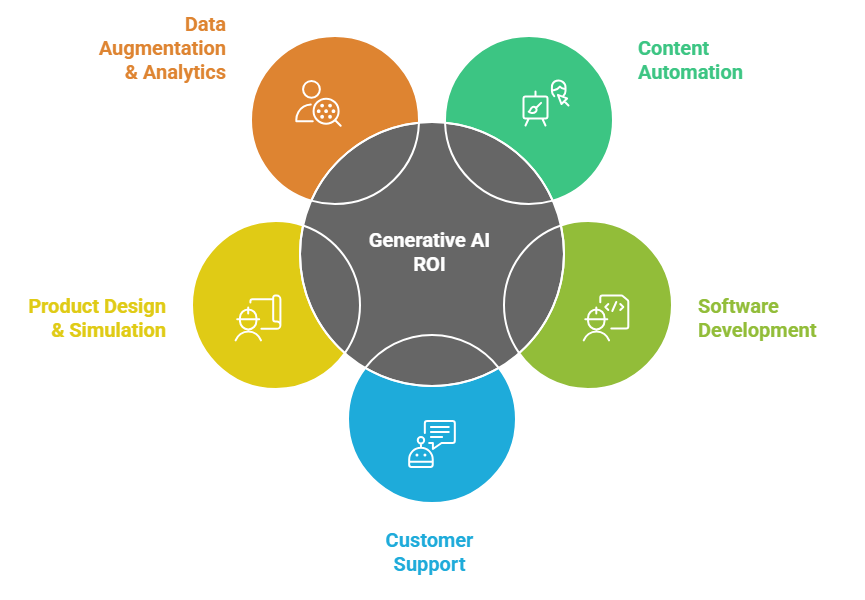
Marketing teams use generative AI to produce blog posts, social media content, email campaigns, and product descriptions at scale, maintaining brand consistency while reducing content production time from weeks to hours.
Development teams integrate AI coding assistants to generate code snippets, debug applications, and automate testing processes. Many developers report 30 to 50 percent productivity improvements in routine tasks.
Design professionals leverage generative tools to create product mockups, architectural renderings, and industrial designs. These tools enable rapid concept iteration while optimizing specifications for manufacturing efficiency and cost effectiveness.
Organizations deploy intelligent chatbots and virtual assistants to handle customer inquiries, provide technical support, and process service requests, offering continuous availability while reducing workload on human agents.
Companies generate synthetic datasets for training machine learning models and create data visualizations, reports, and analytical insights, accelerating decision-making processes and reducing dependency on specialized analysts.Read more about Generative AI for Marketing: Application & Best Practices
Smart organizations recognize generative AI as a strategic investment that delivers measurable business value through enhanced operational efficiency, reduced costs, and new revenue opportunities.
Organizations implement generative AI to unlock multiple value creation pathways, from automating costly manual processes to developing innovative products that generate new revenue streams and competitive advantages.
Companies develop new AI-powered products and services, creating additional revenue streams while entering previously inaccessible markets with innovative solutions that competitors cannot easily replicate or match.
Businesses automate routine tasks and processes using generative AI, reducing labor costs by up to 40 percent while maintaining quality standards and eliminating human error in repetitive workflows.
Organizations compress development cycles from months to weeks by automating design, testing, and documentation processes. This enables faster product launches and a competitive advantage in dynamic market conditions.
AI-powered personalization and support systems increase customer satisfaction scores by 25 percent while reducing service costs, leading to higher retention rates and increased customer lifetime value.
Teams accomplish more complex tasks in shorter timeframes using AI assistance, with knowledge workers reporting 2x to 3x productivity improvements in content creation, analysis, and strategic planning activities.
Leading industries demonstrate measurable returns from generative AI investments, with manufacturing, healthcare, and technology sectors reporting the highest value creation through strategic implementation and adoption.
Manufacturing companies use generative AI for predictive maintenance, quality control automation, and supply chain optimization, achieving 15% to 30% reductions in downtime and operational expenses through intelligent process management.
Healthcare organizations implement AI for drug discovery acceleration, diagnostic imaging enhancement, and personalized treatment planning, reducing research timelines by years while improving patient outcomes and care delivery efficiency.
Software companies integrate generative AI features into their platforms, increasing user engagement by 40% while reducing customer churn through enhanced functionality and automated customer success initiatives.
Financial institutions deploy AI for fraud detection, risk assessment automation, and regulatory reporting, achieving faster compliance processes while maintaining accuracy and reducing operational risk exposure.
Retail businesses leverage generative AI for inventory optimization, personalized marketing campaigns, and dynamic pricing strategies, increasing conversion rates while improving customer satisfaction metrics.
Accurate ROI calculation requires a comprehensive analysis of investment costs and returns, including tangible financial benefits and value creation across operational and strategic business dimensions.
Understanding total implementation costs helps organizations budget effectively and set realistic expectations for generative AI projects, ensuring proper resource allocation and timeline planning for successful deployment.
Organizations typically invest $50,000 to $500,000 annually in AI platform subscriptions, API usage fees, and enterprise software licenses, with costs scaling based on usage volume and feature requirements.
Companies spend $150,000 to $300,000 per AI specialist for salaries, benefits, and retention bonuses, with additional recruiting costs averaging $25,000 to $50,000 per successful technical hire in competitive markets.
Businesses allocate $2,000 to $10,000 per employee for AI literacy programs, technical workshops, and certification courses, ensuring teams can effectively utilize new tools and maximize productivity gains.
Technical implementation requires $100,000 to $1,000,000 for API integrations, data pipeline development, security configurations, and cloud infrastructure setup, depending on organizational complexity and existing technology stack.
Annual maintenance costs range from 15 to 25 percent of the initial implementation investment, covering system updates, technical support, performance monitoring, and security maintenance for sustained operation.
Measurable financial benefits provide clear justification for AI investments, with organizations tracking specific metrics like time savings, productivity improvements, and direct cost reductions across business functions.
Teams report a 40% to 70% reduction in task completion times for content creation, data analysis, and routine documentation, translating to a $100,000 to $500,000 annual value per department.
Organizations achieve 2x to 4x productivity increases in creative and analytical work, with employees completing more projects while maintaining or improving quality standards and meeting tighter deadlines.
Companies reduce operational expenses by 20 to 50% by automating manual processes, eliminating third-party services, and optimizing resource allocation across departments.
Strategic benefits create long-term competitive advantages that may not appear immediately in financial statements but contribute to market positioning, customer loyalty, and sustainable business growth.
AI-powered innovation cycles enable faster product development, unique feature creation, and market entry opportunities that establish competitive advantages and capture greater market share over time.
Improved service quality, personalized interactions, and faster response times increase customer loyalty, reduce churn rates, and generate positive word of mouth marketing that drives organic growth.
Early AI adoption positions organizations as technology leaders, attracting top talent, premium partnerships, and investor interest while building a reputation as forward-thinking industry innovators.
You can calculate generative AI ROI using this comprehensive framework:
ROI = (Total Benefits - Total Costs) / Total Costs × 100.
Let’s take an example:
If a company’s annual benefits equal $800,000 and total investment costs equal $500,000, the ROI equals 60 percent, indicating strong returns that justify continued investment and potential expansion.
Organizations achieve the highest returns by focusing on specific business functions where AI creates measurable value, from content automation to product development acceleration.
Marketing departments leverage generative AI to transform content workflows, enabling faster campaign development and personalized customer engagement while reducing external agency dependencies and operational costs.
AI produces blog posts, social media content, and email campaigns in minutes.
Teams generate hundreds of content variations, create personalized messaging, and optimize for SEO automatically.
Companies save $200,000 to $500,000 annually on content creation while increasing email open rates by 30 percent.
Social media engagement improves by 45 percent with faster campaign deployment.
Development teams integrate AI coding assistants to accelerate software creation, improve code quality, and reduce debugging time, enabling faster product launches and more efficient development cycles.
AI writes code snippets, generates unit tests, and identifies bugs automatically.
Developers use tools like GitHub Copilot to complete functions and optimize code for better performance.
Organizations accelerate product launches by 2 to 6 months while decreasing maintenance expenses by 25 percent.
Development teams require 20 percent fewer resources for project completion.
Organizations deploy AI-powered customer service solutions to handle routine inquiries, provide instant support, and improve customer satisfaction while reducing operational costs and human agent workload.
AI chatbots handle customer conversations with natural language processing and access knowledge bases.
Self service portals help customers troubleshoot problems through guided workflows and tutorials.
Companies decrease response times from 15 minutes to 3 minutes per inquiry while resolving 70 to 85 percent of issues automatically.
Using generative AI, customer retention rates increase by 15 percent.
Design teams utilize generative AI for rapid prototyping, optimization, and testing across manufacturing, architecture, and product development, reducing design cycles and improving innovation outcomes.
AI creates multiple design variations based on material constraints and performance requirements.
Engineering teams generate optimized solutions that improve functionality while reducing material usage and weight.
Organizations reduce prototyping costs by 50 to 80 percent and save $500,000 to $2,000,000 annually.
Design cycles accelerate from months to weeks with improved quality.
Organizations leverage generative AI to create synthetic datasets, enhance machine learning models, and generate analytical insights, improving decision-making capabilities while reducing data collection costs.
AI creates synthetic datasets that supplement real-world data for machine learning training.
Healthcare and financial organizations generate realistic data while protecting privacy and sensitive information.
Organizations achieve 15 to 30 percent better model accuracy while reducing data acquisition costs by 60 to 90 percent.
Teams complete development 40 percent faster.
Read more about Building an Optimized Generative AI Tech Stack
Organizations across industries demonstrate measurable returns from generative AI investments through documented case studies that showcase specific productivity improvements, cost savings, and revenue growth across different business functions.
Wayfair, the leading online furniture retailer, implemented generative AI to automate its product catalog enrichment processes. The company now updates product attributes 5x faster than before, achieving significant operational cost savings while maintaining catalog quality.
This automation enables Wayfair to process thousands of product descriptions, specifications, and marketing content much more efficiently. The implementation demonstrates how large scale retailers can leverage AI to streamline content operations while reducing manual workload and improving accuracy across massive product inventories.
Source: Google Cloud Blog - Real-world gen AI use cases from industry leaders
United Wholesale Mortgage transformed its mortgage processing operations using Vertex AI, Gemini, and BigQuery, achieving more than double underwriter productivity in just nine months. This dramatic improvement resulted in shorter loan closing times for 50,000 brokers and their clients, directly improving customer satisfaction and business efficiency.
The implementation showcases how enterprise financial services can leverage generative AI to accelerate complex document processing and decision-making workflows while maintaining regulatory compliance and quality standards.
Source: Google Cloud Blog - Real-world gen AI use cases from industry leaders
Understanding potential obstacles helps organizations avoid common pitfalls that reduce generative AI returns and implement more effective strategies for sustainable value creation.
Organizations often choose AI applications that provide minimal business impact or require complex implementations with uncertain outcomes. Starting with low-value tasks delays meaningful results and wastes resources on projects that cannot demonstrate clear ROI.
Many companies attempt AI implementation without properly structured, clean, or accessible data, leading to poor model performance and unreliable outputs. Insufficient data quality creates additional costs for cleaning and preparation while reducing the accuracy of AI-generated results.
Existing technology infrastructure may not support modern AI tools, requiring expensive upgrades or custom development to connect new solutions. Complex integration projects often exceed budgets and timelines while creating technical debt that increases long-term maintenance costs.
Teams that deploy AI without proper human review processes risk quality issues, compliance problems, and customer dissatisfaction from automated errors. Excessive automation can lead to loss of institutional knowledge and reduced ability to handle exceptions or complex scenarios.
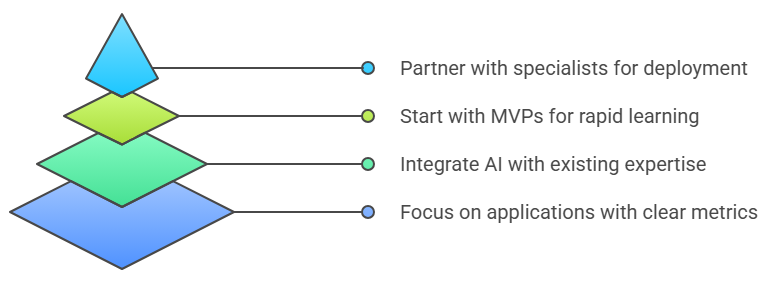
Strategic implementation approaches ensure organizations achieve maximum value from AI investments while avoiding common pitfalls that reduce returns and business impact.
Focus on applications that address pressing business pain points or create substantial value through automation and improved efficiency. Prioritize projects with clear metrics and measurable outcomes that directly contribute to revenue growth or cost reduction.
Integrate AI tools with existing expertise and business processes to create more accurate and relevant outputs for specific industry requirements. Domain knowledge ensures AI applications align with business context and produce results that meet quality and compliance standards.
Begin with minimum viable products that demonstrate value quickly and allow for rapid learning and improvement based on user feedback. Iterative development reduces risk while enabling teams to refine approaches and scale successful implementations across larger business areas.
Partner with specialists like Folio3 who understand both AI technology and business implementation to accelerate deployment and avoid common mistakes. Experienced partners provide proven methodologies and technical expertise that reduce implementation time and improve project success rates.
Yes, organizations that approach generative AI strategically with clear goals and proper implementation consistently achieve positive returns while avoiding common pitfalls that reduce value.
It's not about replacing humans, it's about augmenting them. The highest ROI comes from AI implementations that enhance human capabilities rather than attempting to replace skilled workers entirely. Augmentation approaches create sustainable competitive advantages while maintaining the human judgment and creativity essential for business success.
Explore more about Generative AI In Manufacturing
Folio3 AI delivers comprehensive generative AI solutions that maximize business ROI through strategic implementation, custom model development, and proven methodologies backed by 15+ years of experience.
Custom AI Model Development and Fine Tuning Folio3 specializes in building tailored generative AI models using GANs, transformers, and reinforcement learning technologies that align perfectly with your specific business strategies and operational workflows.
End to End Strategic Planning and Deployment Our team provides complete strategic guidance from opportunity identification to goal definition and seamless system integration, ensuring AI solutions deliver measurable returns across your organization.
Ongoing Optimization and Industry Expertise With 1000+ enterprise clients and 20+ pre-built models deployed globally, Folio3 offers continuous model updates and performance optimization to maintain effectiveness as businesses scale.
The ROI of generative AI is real and measurable for organizations that approach implementation strategically. While generative AI is not a magic solution, companies that choose appropriate use cases, invest in proper training, and maintain human oversight consistently achieve strong returns. AI delivers tangible business value across industries, from content automation that reduces marketing costs by 60 percent to development tools that accelerate product launches.
Success requires realistic expectations, proper planning, and focus on augmenting human capabilities rather than replacing them entirely. Organizations ready to maximize their generative AI ROI should partner with experienced providers who understand both technology capabilities and business requirements.
Ready to see what kind of ROI generative AI can deliver for your business? Let's talk
{ "@context": "https://schema.org", "@type": "FAQPage", "mainEntity": [ { "@type": "Question", "name": "Are generative AI investments worth it?", "acceptedAnswer": { "@type": "Answer", "text": "Yes, because they reduce operational costs, accelerate workflows, and unlock new revenue streams. The ROI depends on the use case, but most enterprises see measurable returns within the first 12–18 months." } }, { "@type": "Question", "name": "How long does it take to see ROI from generative AI investments?", "acceptedAnswer": { "@type": "Answer", "text": "Most organizations begin seeing measurable returns within 3 to 6 months of implementation, with full ROI typically achieved within the first year. Early wins often come from automation of routine tasks and improved efficiency in content creation and customer support." } }, { "@type": "Question", "name": "What is the average cost of implementing generative AI for mid-size businesses?", "acceptedAnswer": { "@type": "Answer", "text": "Implementation costs typically range from $100,000 to $500,000 for mid-size businesses, including software licensing, integration, and training. However, most companies recover these costs through productivity gains and operational savings within 12 to 18 months." } }, { "@type": "Question", "name": "How to measure ROI of generative AI implementations in large organizations?", "acceptedAnswer": { "@type": "Answer", "text": "By tracking KPIs such as productivity gains, cost savings, customer engagement improvements, error reduction, and time-to-market acceleration. Benchmarking before and after implementation is key." } }, { "@type": "Question", "name": "Do businesses need technical expertise to implement generative AI successfully?", "acceptedAnswer": { "@type": "Answer", "text": "While technical knowledge helps, partnering with experienced AI development companies like Folio3 allows businesses to implement solutions without extensive in-house expertise. Professional guidance ensures proper strategy, deployment, and ongoing optimization for maximum ROI." } }, { "@type": "Question", "name": "Which areas of a business typically see the fastest ROI from AI automation?", "acceptedAnswer": { "@type": "Answer", "text": "Customer support, IT operations, marketing content creation, and supply chain optimization often deliver quick ROI due to repetitive workflows and high-volume tasks." } }, { "@type": "Question", "name": "What is the ROI of using an API client generation tool?", "acceptedAnswer": { "@type": "Answer", "text": "Such tools save development hours, reduce integration costs, and minimize errors in software projects, making them high-ROI for tech-driven organizations." } }, { "@type": "Question", "name": "How can enterprises measure ROI from generative AI implementations?", "acceptedAnswer": { "@type": "Answer", "text": "Enterprises track ROI using metrics such as reduced labor costs, accelerated project timelines, improved revenue per employee, and customer retention rates. Advanced analytics dashboards often integrate AI and specific KPIs to quantify performance improvements over time." } }, { "@type": "Question", "name": "What generative AI platforms offer the best ROI for manufacturing industries?", "acceptedAnswer": { "@type": "Answer", "text": "Platforms like OpenAI GPT-4, Google Vertex AI, and custom generative AI solutions tailored for manufacturing workflows offer strong ROI. Key benefits include design optimization, automated maintenance scheduling, and faster product development cycles." } }, { "@type": "Question", "name": "What is the primary ROI of integrating generative AI into business workflows?", "acceptedAnswer": { "@type": "Answer", "text": "The primary ROI comes from automating repetitive tasks, reducing human error, and accelerating innovation. These improvements directly translate into cost savings, faster time-to-market, and enhanced employee productivity." } }, { "@type": "Question", "name": "How do regulatory compliance and security affect ROI from generative AI?", "acceptedAnswer": { "@type": "Answer", "text": "Compliance and security investments upfront can improve ROI long-term by reducing risks, avoiding penalties, and building customer trust. Secure and compliant AI deployments enable sustainable scaling of AI across enterprise functions." } } ] }
Yes, because they reduce operational costs, accelerate workflows, and unlock new revenue streams. The ROI depends on the use case, but most enterprises see measurable returns within the first 12–18 months.
Most organizations begin seeing measurable returns within 3 to 6 months of implementation, with full ROI typically achieved within the first year. Early wins often come from automation of routine tasks and improved efficiency in content creation and customer support.
Implementation costs typically range from $100,000 to $500,000 for mid-sized businesses, including software licensing, integration, and training. However, most companies recover these costs through productivity gains and operational savings within 12 to 18 months.
By tracking KPIs such as productivity gains, cost savings, customer engagement improvements, error reduction, and time-to-market acceleration. Benchmarking before and after implementation is key.
While technical knowledge helps, partnering with experienced AI development companies like Folio3 allows businesses to implement solutions without extensive in-house expertise. Professional guidance ensures proper strategy, deployment, and ongoing optimization for maximum ROI.
Customer support, IT operations, marketing content creation, and supply chain optimization often deliver quick ROI due to repetitive workflows and high-volume tasks.
Such tools save development hours, reduce integration costs, and minimize errors in software projects, making them high-ROI for tech-driven organizations.
Enterprises track ROI using metrics such as reduced labor costs, accelerated project timelines, improved revenue per employee, and customer retention rates. Advanced analytics dashboards often integrate AI and specific KPIs to quantify performance improvements over time.
Platforms like OpenAI GPT-4, Google Vertex AI, and custom generative AI solutions tailored for manufacturing workflows offer strong ROI. Key benefits include design optimization, automated maintenance scheduling, and faster product development cycles.
The primary ROI comes from automating repetitive tasks, reducing human error, and accelerating innovation. These improvements directly translate into cost savings, faster time-to-market, and enhanced employee productivity.
Compliance and security investments upfront can improve ROI long-term by reducing risks, avoiding penalties, and building customer trust. Secure and compliant AI deployments enable sustainable scaling of AI across enterprise functions.