
Loading...
Fleet managers across America are discovering that fleet management for electric vehicles requires different approaches than managing traditional fleets. They face immediate challenges when electric vehicles require charging during active routes, or when winter conditions reduce battery range by up to 50%.
According to the International Energy Agency, projections indicate 17 million EV sales by the end of 2024, with electric cars accounting for 20% of total car sales. Looking ahead, the global EV stock is expected to reach nearly 250 million vehicles by 2030, with sales share potentially exceeding 50% by 2035. This rapid adoption means businesses need management systems built specifically for electric operations.
Traditional fleet software can't handle battery monitoring, charging optimization, and range planning that electric vehicles demand. Companies are turning to scalable platforms that grow with their operations while solving these unique challenges.

Managing electric vehicle fleets requires different approaches than traditional operations, with platforms that adapt to growing fleets and evolving technology.
Major logistics companies are committing to carbon-neutral operations. FedEx announced a goal to achieve carbon-neutral operations globally by 2040, and Amazon is ordering 100,000 electric delivery vehicles as part of its commitment to reach net-zero carbon by 2040..
Electric vehicles require planned charging stops, with Level 2 chargers taking 4-10 hours to charge a BEV from empty, while direct current fast chargers can charge a BEV to 80 percent in 20 minutes to 1 hour. Battery performance varies with temperature and usage patterns, requiring specialized monitoring systems to optimize efficiency and prevent degradation over time.
Today's electric fleets primarily rely on overnight charging and basic route planning, but emerging technologies will transform operations. Vehicle-to-grid (V2G) technology enables energy to be pushed back to the power grid from EV batteries, allowing vehicles to sell demand response services and provide backup energy storage.
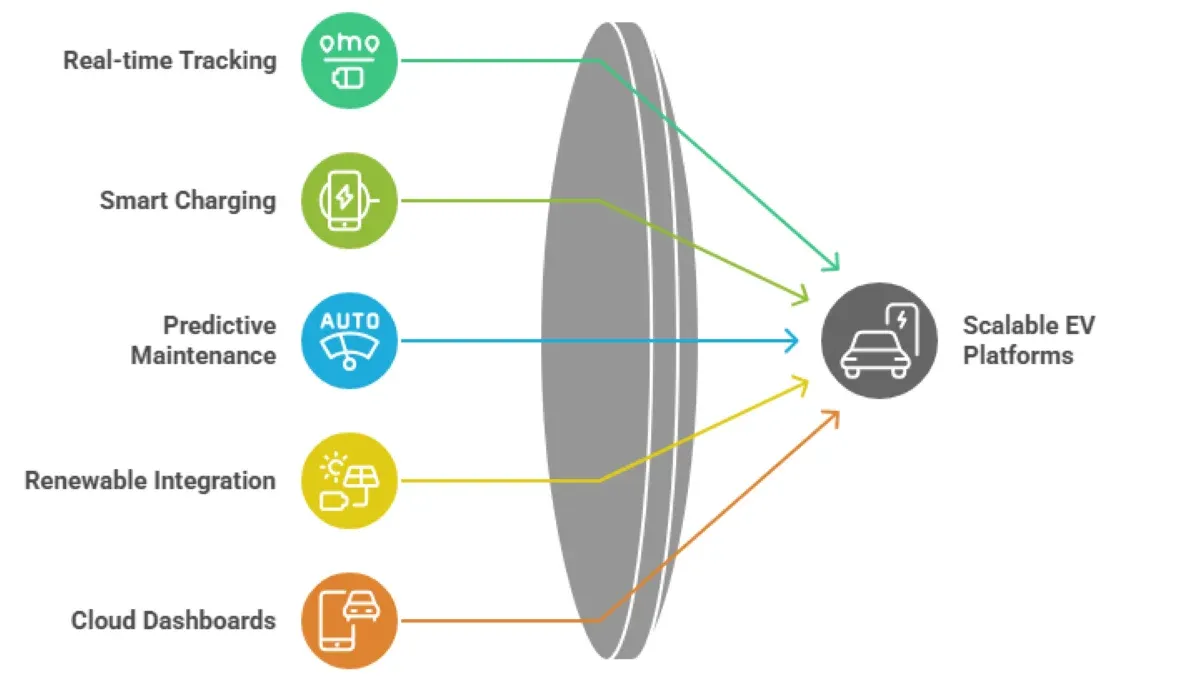
Scalable electric vehicle platforms deliver specialized capabilities that address the unique operational demands of electric fleets through advanced technology solutions and intelligent automation systems.
Platforms display vehicle locations, charging status, and battery levels that fluctuate based on weather, load, and driving patterns. This information updates every few seconds, allowing managers to make immediate decisions about route changes or charging needs.
Systems analyze electricity rates to optimize charging timing for scheduled departures. Advanced algorithms find optimal charging stations along delivery routes while considering vehicle range, available charging locations, traffic conditions, and delivery schedules simultaneously.
Platforms continuously monitor battery health, electric motor performance, and critical system diagnostics to identify potential problems early. AI algorithms learn normal operating patterns for each vehicle and send alerts when performance deviates from expected ranges, preventing costly breakdowns.
Modern platforms integrate seamlessly with public charging networks, workplace stations, solar panels, and wind power installations. They automatically handle different payment systems, schedule charging during off-peak hours, and optimize energy usage rates. Integration with renewable sources can reduce charging costs by up to 40%.
Cloud-based platforms provide instant mobile access through smartphones, tablets, and laptops from any location. Dashboards maintain fast response times, whether managing 20 vehicles or 2,000, displaying real-time performance data and maintenance alerts through user-friendly interfaces.
Several companies offer platforms designed specifically for fleet management for electric vehicles at various scales.
Geotab leads enterprise EV operations with support for 300+ vehicle models and processes 50 billion data points daily for large-scale deployments.
Key features:
Electric Vehicle Suitability Assessment (EVSA) - Analyzes data to create personalized electrification recommendations.
Real-time EV monitoring - Map overlays showing location, state of charge, battery degradation tracking, and range reports.
Comprehensive data analytics - Detailed battery health monitoring, energy consumption tracking, and charging session analysis.
Major customer base - Used by Purolator, the City of Toronto, and other large organizations.
Folio3 partners with transportation companies to build custom AI solutions that leverage cutting-edge machine learning and predictive analytics, backed by over 15 years of proven industry experience.
Key features
Dispatch & Trip Management - Provides real-time vehicle dispatching capabilities, automated driver task scheduling, comprehensive digital work orders and document handling, along with seamless two-way communication systems for drivers.
Route Optimization & Geofencing - Deliver smart route planning based on live traffic data and delivery priorities, featuring dynamic rerouting with real-time alerts and advanced geofence creation with instant breach notifications.
Live Fleet Tracking & Monitoring - GPS/ELD/OBD integration for precise tracking, live dashboards that provide complete vehicle and asset status visibility, driver behavior monitoring, and detailed fuel consumption analytics.
Predictive Analytics & Maintenance - Offer predictive maintenance capabilities, comprehensive fleet utilization reporting, accurate cost per mile tracking, and maintenance trend analysis with intelligent optimization suggestions.
Samsara provides unified monitoring for ICE, EV, and hybrid vehicles with AI-powered optimization, real-time charging status, and enhanced EV integration through their Rivian partnership.
Key features:
Rivian integration - Direct vehicle data access providing GPS location, odometer readings, and state of charge information.
AI-powered optimization - State of charge alerts, charging behavior monitoring, and automated EV assessments.
Sustainability focus - Achieved net zero carbon footprint in 2019 with sustainable bundles and emissions tracking.
Dynamic fleet support - Proven performance with companies like DoorDash and Turo.
Verizon Connect offers unified dashboards for EV and gas vehicles with reliable connectivity, EV suitability analysis, and practical management features.
Key features:
EV Suitability Tool - Ratings based on detailed usage data through NextEra Mobility and Sawatch Labs partnerships.
Real-time monitoring - EV location tracking with battery life remaining, configurable low battery alerts, and detailed charging reports.
Financial analysis integration - Vehicle addition cost analysis, fuel savings projections, and CO2 reduction estimates.
Global infrastructure - Reliable connectivity supporting international operations with different charging standards.
Fleetio recently launched a thorough EV management framework with detailed charging tracking, competitive pricing starting at $5 per vehicle monthly, and mobile collaboration tools.
Key features:
Enhanced monitoring - Vehicle Sensor Charts with battery health tracking, charging status, and state of charge data
Competitive pricing - Plans start at $5 per vehicle monthly for Essential, $7 for Professional, and $10 for Premium
Automated data entry - Charging entries eliminate manual tasks, initially available through Geotab integration
Mobile collaboration - Fleetio Go app enables real-time communication between drivers, technicians, and managers
Artificial intelligence transforms electric vehicle management from reactive to predictive operations that continuously learn and improve fleet performance over time.
AI reduces logistics costs by up to 13% through intelligent route planning and can cut energy expenses by 30 to 50% by scheduling charging during off-peak electricity rates.
Machine learning algorithms process 14 trillion data points to optimize fleet performance, enabling electric trucks to handle 85% of payloads while improving overall productivity.
AI prevents expensive breakdowns by analyzing vehicle diagnostics and sensor data to predict maintenance needs weeks in advance, extending vehicle lifespan and reducing repair costs.
Systems automatically optimize charging schedules, integrate renewable energy sources, and reduce carbon emissions by up to 40% through smart grid coordination and off-peak usage.
AI-powered analytics provide actionable insights for fleet managers, enabling precise EV adoption decisions, route optimization, and operational improvements based on real-time performance data.
Electric vehicle fleet operations present unique operational challenges that require specialized technological solutions and strategic management approaches.
Electric vehicles cost 33% more initially than ICE vehicles, with charging infrastructure requiring additional capital investment of $799 to $1,999 per Level 2 charger installation.
Only 53,000 charging stations exist versus 145,000 gas stations in the US, creating operational constraints and range anxiety for fleet routes and scheduling.
EVs need 30 minutes to several hours for charging compared to 5-minute gas refueling, causing productivity downtime and complicating operational scheduling for fleet managers.
Limited commercial EV model options and supply chain constraints make sourcing appropriate vehicles for specific fleet operational needs difficult, with only 2% citing availability as a barrier.
Fleet drivers express concerns about EV handling differences, charging procedures, and range limitations, requiring extensive retraining programs and change management to ensure successful adoption.
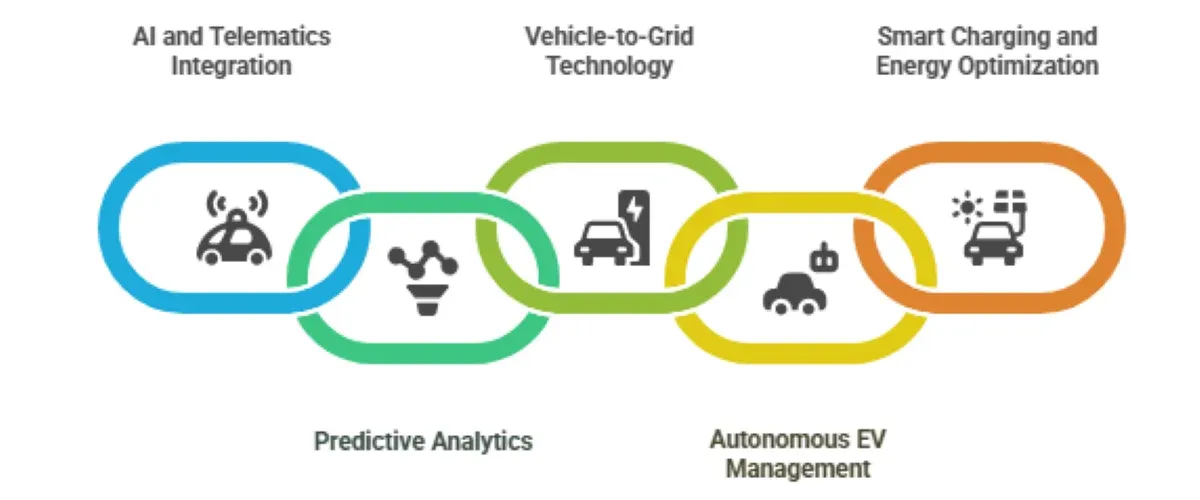
Fleet management for electric vehicles continues advancing with emerging technologies promising improved operational capabilities and autonomous integration by 2030.
Advanced AI algorithms analyze telematics data to identify optimization patterns invisible to traditional methods, enabling real-time adaptation and continuous operational improvement through machine learning models.
Analytics transform fleet management from reactive to proactive by predicting maintenance needs, battery degradation, and operational challenges weeks in advance using historical data and sensors.
V2G systems allow electric vehicles to sell excess battery capacity back to electrical grids during peak demand, becoming standard by 2030 for revenue generation.
Self-driving electric vehicles will optimize their own routes, charging schedules, and operational parameters without human intervention, coordinating fully autonomous fleets through integrated AI systems.
Cloud native platforms integrate renewable energy sources, optimize charging schedules based on electricity rates, and automatically balance grid demand to minimize costs and environmental impact.
Folio3 develops custom AI-powered solutions addressing specific fleet management challenges through tailored technology implementations and enterprise-grade architectures.
Folio3 conducts thorough operational analysis to understand fleet challenges, industry regulations, and business processes. Custom AI models are trained on historical data patterns, integrating seamlessly with existing telematics systems, ERP platforms, and CRM databases through robust APIs and middleware layers.
Machine learning algorithms, including random forests, neural networks, and deep learning models, analyze vast datasets from vehicle sensors and GPS tracking. Predictive maintenance uses time series analysis, while route optimization processes real-time traffic data using advanced optimization techniques.
Cloud-native architectures utilize microservices, Docker containerization, and Kubernetes orchestration with distributed databases that automatically scale based on fleet size. Event-driven systems with message queues and load balancers handle traffic spikes while maintaining sub-second response times.

{ "@context": "https://schema.org", "@type": "FAQPage", "mainEntity": [ { "@type": "Question", "name": "What is the best scalable platform for electric vehicles?", "acceptedAnswer": { "@type": "Answer", "text": "The best platform depends on fleet size and needs. Enterprise-level solutions handle large deployments, while AI-powered platforms excel for automation and mixed fleets. Custom-built platforms fit unique operational requirements." } }, { "@type": "Question", "name": "Why do EV fleets need specialized management tools?", "acceptedAnswer": { "@type": "Answer", "text": "EVs require battery health monitoring, charging optimization, and range prediction that standard fleet tools don't provide, including managing charging infrastructure and battery degradation." } }, { "@type": "Question", "name": "How can AI improve electric vehicle operations?", "acceptedAnswer": { "@type": "Answer", "text": "AI reduces costs by 30-50% through optimized charging schedules, predictive maintenance, and energy consumption analysis for better efficiency." } }, { "@type": "Question", "name": "What are the key features of EV management software?", "acceptedAnswer": { "@type": "Answer", "text": "Key features include real-time battery monitoring, off-peak charging optimization, range-aware route planning, predictive maintenance alerts, and charging infrastructure integration." } }, { "@type": "Question", "name": "Can I manage both EVs and fuel-based vehicles in one platform?", "acceptedAnswer": { "@type": "Answer", "text": "Yes, modern platforms support mixed fleets, offering tools for both EVs and traditional vehicles under one unified dashboard." } }, { "@type": "Question", "name": "Which tools offer real-time battery tracking?", "acceptedAnswer": { "@type": "Answer", "text": "Enterprise fleet platforms provide live battery charge and health tracking, integrating telematics for battery degradation, state of charge, and charging session monitoring." } }, { "@type": "Question", "name": "How do platforms optimize EV charging schedules?", "acceptedAnswer": { "@type": "Answer", "text": "They analyze electricity rates, grid demand, vehicle schedules, and station availability to determine optimal charging times, often integrating renewable sources." } }, { "@type": "Question", "name": "What are the biggest challenges in EV tracking?", "acceptedAnswer": { "@type": "Answer", "text": "Challenges include coordinating slower charging, managing battery degradation, ensuring accurate range prediction, and handling increased data complexity." } }, { "@type": "Question", "name": "Is EV management software expensive?", "acceptedAnswer": { "@type": "Answer", "text": "It ranges from $5-$50 per vehicle monthly. However, savings from optimized charging and predictive maintenance often offset costs within 12-18 months." } }, { "@type": "Question", "name": "Can I integrate EV data into existing logistics software?", "acceptedAnswer": { "@type": "Answer", "text": "Yes, most platforms provide APIs for integrating EV data with logistics, ERP, and BI systems, enabling unified dashboards without system replacements." } } ] }
The best platform depends on your specific needs and fleet size. Enterprise-level solutions excel for large deployments with extensive data processing capabilities, while AI-powered platforms offer superior automation for mixed fleets. Custom-built solutions work best for unique operational requirements that standard platforms cannot address.
Electric vehicles require battery health monitoring, charging optimization, and range prediction that standard tools don't provide. Traditional software can't handle EV-specific needs like coordinating charging infrastructure or managing battery degradation patterns.
AI optimizes charging schedules based on electricity rates and grid demand, potentially reducing energy costs by 30-50%. Machine learning algorithms also predict maintenance needs before breakdowns occur and analyze energy consumption patterns for better efficiency.
Essential features include real-time battery monitoring, charging optimization during off-peak hours, and range-aware route planning. The software must also provide predictive maintenance alerts and integrate seamlessly with charging infrastructure networks.
Most modern platforms handle mixed fleets effectively by providing appropriate tools for each vehicle type while maintaining unified oversight. This simplifies operations during the transition period when companies gradually switch from gas to electric vehicles.
Enterprise fleet management platforms provide detailed battery monitoring with real-time charge levels and health status tracking. These systems update every few seconds and offer mobile access for remote monitoring. Advanced telematics solutions integrate with vehicle sensors to track battery degradation, state of charge, and charging session data for optimal fleet performance.
Platforms analyze electricity rates, grid demand, vehicle schedules, and charging station availability to determine optimal charging times. Advanced systems integrate with renewable energy sources and utility programs to further reduce costs.
Major challenges include coordinating the charging infrastructure since charging takes much longer than refueling. Battery degradation management, range prediction accuracy, and handling increased data complexity also present ongoing operational difficulties.
Costs typically range from $5 to $50 per vehicle monthly, depending on features and fleet size. However, operational savings from optimized charging and predictive maintenance usually justify the investment within 12-18 months.
Most modern platforms offer API integration capabilities for seamless data sharing with existing logistics, ERP, and business intelligence systems. This enables unified operational dashboards without requiring complete system replacements.