
Loading...
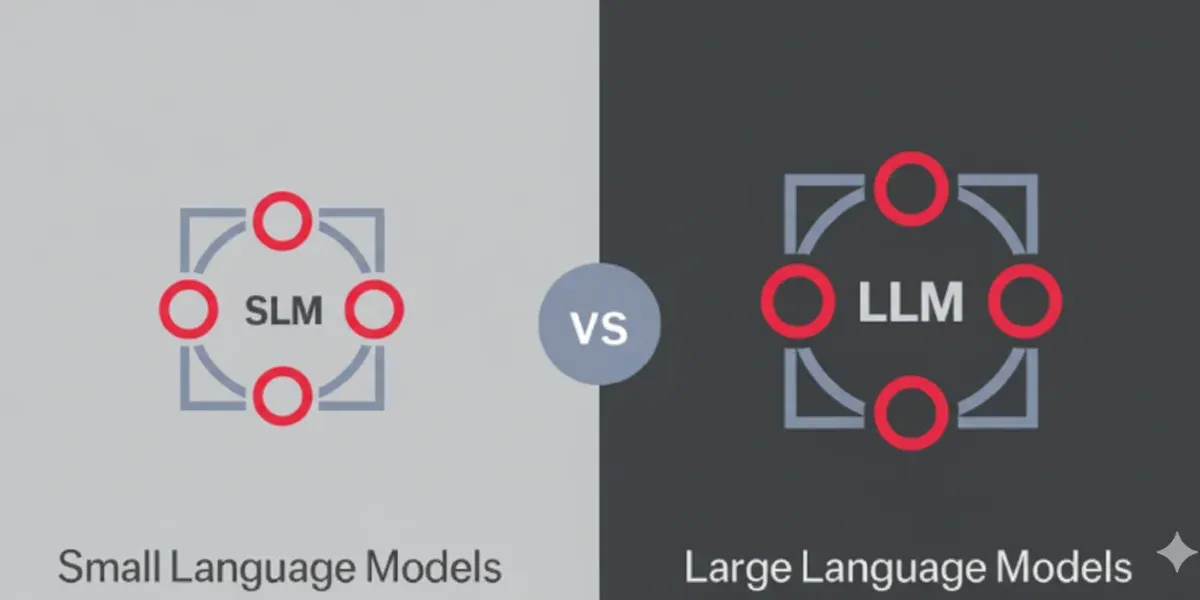
Your organization just allocated millions for an AI initiative. Six months later, you're drowning in infrastructure costs, dealing with latency issues, and questioning every decision. Sound familiar? The choice between small language models (SLMs) and large language models (LLMs) isn't just technical; it's the difference between AI success and expensive failure.
Here's what most enterprises miss: according to recent industry analysis, organizations often experience significantly faster implementation timelines with domain-specific AI solutions compared to general-purpose systems. But here's the real question: how do you know which model type fits your use case? The distinction between small language models (SLMs) and large language models (LLMs) extends far beyond parameter count; it encompasses architecture, training methodology, inference costs, and strategic business alignment.
This guide breaks down exactly when to deploy each model type, what it costs, and how to avoid the expensive mistakes your competitors are making right now.
CriteriaSmall Language Models (SLMs)Large Language Models (LLMs)Parameter count1-20 billion parameters100+ billion to trillionsTraining datasetDomain-specific, curated datasetsMassive, broad datasets (web-scale)Inference speedFast (milliseconds)Slower (seconds)Hardware requirementsSingle GPU, mobile devices, edge devicesMultiple high-end GPUs or clustersTraining costThousands to hundreds of thousandsMillions to tens of millionsInference costLow operational expenseHigh ongoing costsDeployment locationOn-premise, edge, mobilePrimarily cloud-based, data centersContext window2K-8K tokens32K-1M+ tokensUse casesTask-specific, domain expertiseGeneral-purpose, multi-domain tasksFine-tuning timeHours to daysWeeks to monthsData privacyHigh (on-device, local deployment)Lower (API calls, cloud processing)Accuracy on specialized tasksHigh (when properly trained)Moderate (requires fine-tuning)General knowledgeLimited to the training domainExtensive across multiple domainsExamplesMistral 7B, Phi-3, Gemma, BERTGPT-4, Claude, Gemini Ultra
A large language model is an AI system trained on massive datasets containing billions to trillions of parameters, designed to understand and generate human-like text across multiple domains. These models use transformer-based architectures with self-attention mechanisms to process and predict language patterns. LLMs like GPT-4, Claude, and Gemini Ultra are trained on diverse internet data, enabling them to handle complex reasoning, multimodal inputs, creative generation, and multi-step workflows.
The scale of these models, often exceeding 100 billion parameters, allows them to capture intricate language nuances and contextual relationships that smaller models cannot. Their comprehensive training on web-scale data provides broad general knowledge spanning industries, languages, and subject matter areas.
Large language models deliver exceptional versatility through their massive scale and comprehensive training, making them powerful tools for enterprises requiring broad AI capabilities across diverse applications.
LLMs contain hundreds of billions to trillions of parameters, enabling them to capture complex language patterns and relationships. ChatGPT, for instance, was trained using trillions of parameters to respond to a wide range of human queries. This scale allows for nuanced understanding across contexts, maintaining coherence through long conversations and processing intricate linguistic structures.
These models train on extensive internet data, including the entire public internet, academic papers, books, and code repositories, providing comprehensive knowledge across industries and subjects. This breadth enables them to handle questions spanning healthcare, legal, technical, and creative domains simultaneously without specialized training.
Modern LLMs support context windows ranging from 32,000 tokens to over 1 million tokens, allowing them to process entire documents, codebases, or extended conversation histories. This capability enables complex document analysis, long-form content generation, and maintaining coherent multi-turn dialogues that reference earlier exchanges throughout lengthy interactions.
LLMs demonstrate sophisticated chain-of-thought reasoning, breaking down complex problems into logical steps. They can perform calculations, analyze multi-step workflows, synthesize information from multiple sources, and provide detailed explanations of their decision-making processes with human-like reasoning patterns.
Leading LLMs now integrate vision, audio, and text processing capabilities, enabling them to analyze images, transcribe audio, generate visual content, and understand relationships across different media types within a single unified model architecture for comprehensive information processing.

A small language model is an optimized AI system containing 1 to 20 billion parameters, designed explicitly for efficient deployment and task-specific performance. Unlike their larger counterparts, SLMs leverage techniques like quantization, distillation, and pruning to achieve remarkable efficiency while maintaining strong domain-specific accuracy.
Models like Mistral 7B (with 7 billion parameters), Phi-3, Gemma, and specialized BERT variants exemplify this category. SLMs excel at targeted applications where speed, cost-efficiency, and on-device deployment matter more than broad general knowledge.
Their compact architecture enables deployment on edge devices, mobile phones, and standard servers while delivering millisecond-level inference speeds for real-time applications.
Small language models prioritize efficiency and specialization, delivering targeted performance with significantly reduced computational requirements, making them ideal for enterprise applications requiring speed and cost control.
SLMs employ streamlined architectures with techniques like sliding window attention, quantization to reduce memory footprint, and model distillation from larger models. Mistral 7B, for example, uses sliding window attention in a decoder-only model for efficient training, enabling it to deliver strong performance while using significantly fewer parameters than large language models.
Rather than training on general internet data, SLMs focus on curated, domain-specific datasets for healthcare, legal, finance, or customer service. This targeted training delivers superior accuracy within their specialty while eliminating irrelevant information that increases costs without adding value to specific enterprise applications.
SLMs run efficiently on smartphones, IoT devices, and edge servers without cloud connectivity. Their smaller model size means they can operate on local machines with standard GPU configurations, enabling real-time translation, voice assistants, and privacy-sensitive applications where data cannot leave the device.
With fewer parameters to process, SLMs deliver responses in milliseconds compared to seconds for LLMs. This speed advantage proves critical for real-time applications like chatbots, autocomplete, fraud detection, and interactive voice systems requiring immediate responses without noticeable latency.
SLMs reduce inference costs substantially compared to LLMs, processing thousands of requests on single GPUs that would require entire data centers for equivalent LLM workloads. This cost efficiency enables enterprises to scale AI applications profitably while maintaining predictable operational expenses.
Understanding the distinction between training costs and inference costs reveals why many enterprises overestimate AI budgets. Training represents a one-time investment while inference costs scale with usage, making operational efficiency the primary long-term expense factor.
Training large language models demands substantial computational resources. GPT-4, for instance, required 25,000 NVIDIA A100 GPUs running continuously for 90-100 days. In contrast, smaller models can be trained with significantly fewer resources, representing orders of magnitude cost reduction while still delivering strong domain-specific performance.
Inference costs dominate long-term AI budgets, particularly as application usage scales. LLMs require substantial compute per request compared to SLMs, which process queries efficiently on minimal infrastructure. An enterprise processing millions of requests monthly experiences dramatically different operational costs between model types.
LLMs require multiple parallel GPUs to handle concurrent requests, with performance degrading as user volume increases. SLMs maintain consistent sub-second response times even under heavy load. Some optimized models like Granite can fit on a single V100-32GB GPU, supporting thousands of simultaneous users without additional infrastructure investment.
Fine-tuning LLMs requires weeks of compute time on high-end GPU clusters, representing a substantial investment depending on dataset size and model complexity. SLMs fine-tune in hours to days on single GPUs, with significantly lower total costs for comparable performance improvements in specialized domains.
LLM deployments demand dedicated DevOps teams, sophisticated orchestration systems, and enterprise-grade data centers with specialized cooling and power infrastructure. SLMs run on standard servers or edge devices, reducing operational complexity and enabling deployment by existing IT teams without specialized infrastructure procurement.
Strategic model selection aligns AI capabilities with specific business requirements, balancing accuracy needs against cost constraints. The right architecture choice maximizes ROI while avoiding over-engineering or under-delivering on performance expectations.
Deploy SLMs for handling the majority of routine customer queries about account status, password resets, and FAQ responses. Reserve LLMs for complex complaints, escalations, and multi-issue resolutions requiring broad contextual understanding and creative problem-solving across various scenarios.
Use SLMs for high-volume document classification, invoice processing, and data extraction where speed and cost matter more than nuanced interpretation. Apply LLMs for legal contract analysis, medical record summarization, and research synthesis requiring deep comprehension and reasoning.
Implement SLMs for code completion, syntax checking, and generating boilerplate code within established frameworks where patterns are predictable. Leverage LLMs for architectural design, debugging complex multi-file issues, and translating requirements into new codebases requiring creative problem-solving.
SLMs enable privacy-preserving translation, voice assistants, and predictive text on smartphones without internet connectivity or data exposure. LLMs remain server-side for applications requiring extensive world knowledge, real-time information retrieval, or compute-intensive multimodal processing.
Design systems where SLMs triage incoming requests, handling the majority of routine tasks autonomously while routing complex edge cases to LLMs. This architecture reduces inference costs substantially while maintaining high-quality responses through intelligent task distribution based on complexity.
A structured evaluation framework prevents costly misalignment between AI capabilities and business requirements. Systematic assessment across multiple dimensions ensures optimal model selection before committing resources to development and deployment.
Evaluate whether tasks require broad general knowledge across domains or deep expertise within narrow specialties. Simple, repetitive tasks with clear patterns favor SLMs, while ambiguous problems requiring reasoning across multiple knowledge areas demand LLMs.
Real-time applications needing sub-second responses, chatbots, fraud detection, and autocomplete require SLM speed. Batch processing, research analysis, and complex generation tasks tolerating multi-second delays accommodate LLM capabilities without compromising user experience.
Model selection hinges on unit economics. Applications processing millions of daily requests, search, recommendations, and content moderation require SLM efficiency. Low-volume, high-value tasks like strategic analysis, legal review, or creative ideation justify LLM expenses.
Regulated industries, like healthcare, finance, and government, often mandate on-premise deployment and data sovereignty. SLMs deployed on local infrastructure meet compliance requirements, while LLMs processed via cloud APIs may violate data governance policies.
Domains with rapidly evolving terminology or requirements, like medical research, legal precedent, and emerging technologies, need frequent retraining. SLMs retrain efficiently with updated domain data, while LLM fine-tuning requires substantial ongoing investment.
Comprehensive TCO analysis reveals hidden expenses beyond initial model selection, preventing budget overruns and enabling accurate ROI projections. Forward-looking cost modeling accounts for scaling patterns and operational realities.
LLM training from scratch demands massive computational investment measured in millions of dollars. SLM training costs substantially less, typically measured in thousands to hundreds of thousands. Fine-tuning pretrained models offers a middle ground with significantly lower costs than training from scratch.
LLM inference requires GPU clusters or cloud compute at scale, creating substantial ongoing monthly expenses. SLMs run on standard infrastructure, costing a fraction of LLM requirements, often using existing servers without specialized hardware procurement or expensive cloud commitments.
LLM deployments require dedicated ML engineers for model monitoring, drift detection, and retraining. SLMs integrate with existing IT operations, adding minimal incremental staffing costs while leveraging current technical teams for deployment and maintenance.
Regulated industries face substantial compliance overhead: data anonymization, audit logging, access controls, and security monitoring. Cloud-based LLM APIs complicate compliance, requiring legal review and custom data handling workflows that increase operational complexity and costs.
Model performance degrades over time as language evolves and business context shifts. Budget ongoing investment for periodic retraining. Additionally, rapid AI advancement creates depreciation risk, as models may become obsolete within relatively short timeframes, requiring replacement or significant updates.
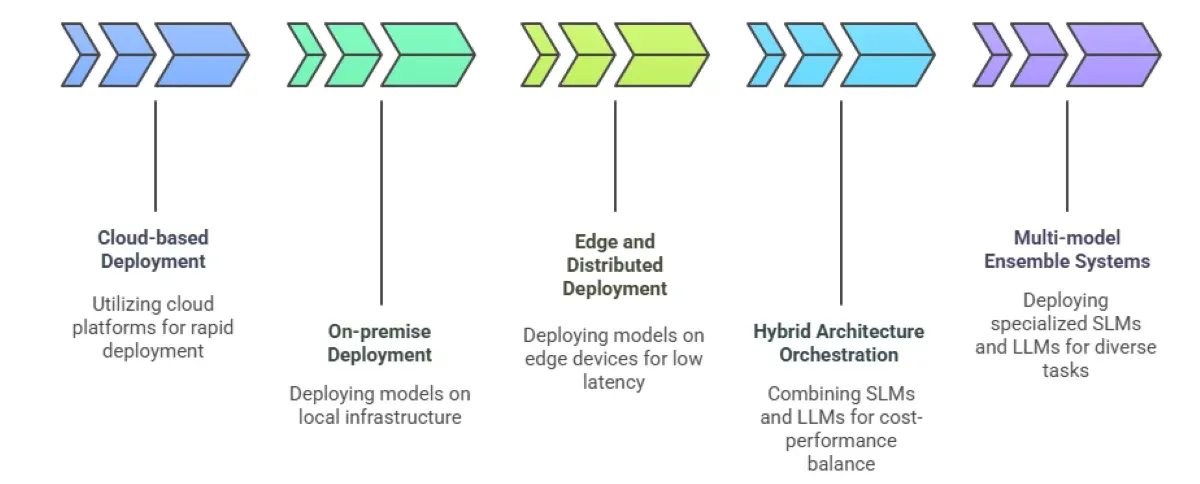
Infrastructure architecture determines long-term operational success, affecting performance, security, scalability, and cost efficiency. Strategic deployment planning balances immediate needs against future growth trajectories and evolving business requirements.
Cloud platforms like AWS SageMaker, Google Vertex AI, and Azure ML provide managed infrastructure for LLM deployment with auto-scaling and global distribution. This approach suits enterprises prioritizing rapid deployment over cost optimization, accepting substantial monthly compute expenses.
Organizations with data sovereignty requirements, existing data center infrastructure, or high-volume applications deploy models on-premise. SLMs excel here, running on standard server hardware while LLMs require specialized GPU clusters, representing significant capital expenditure.
SLMs enable edge deployment on retail kiosks, manufacturing equipment, autonomous vehicles, and mobile devices. This architecture eliminates latency, reduces bandwidth costs, enables offline operation, and keeps sensitive data on-device rather than transmitting to cloud services.
Intelligent routing systems direct requests to SLMs for routine tasks and LLMs for complex queries, optimizing cost-performance tradeoffs. Implement API gateways with classification logic that triages the majority of requests to low-cost SLM endpoints while escalating complex cases.
Deploy multiple specialized SLMs for different domains, customer service, technical documentation, and product recommendations, alongside general-purpose LLMs for edge cases. This architecture delivers domain expertise where needed while maintaining fallback capabilities for unusual scenarios.
Anticipating implementation obstacles prevents costly delays and performance issues. Proactive mitigation strategies address technical limitations, organizational constraints, and operational risks before they derail AI initiatives.
LLMs generate confident but factually incorrect responses, particularly for specialized domains or recent information. Mitigate through retrieval-augmented generation (RAG), fact-checking pipelines, confidence scoring, human-in-the-loop validation, and fine-tuning on curated domain data.
SLMs typically support 2,000-8,000 token context windows versus 32,000-1 million for LLMs, limiting document processing capabilities. Address through document chunking, extractive summarization preprocessing, and hybrid architectures where SLMs handle segments while LLMs synthesize findings.
Training data reflects societal biases, resulting in discriminatory outputs affecting hiring, lending, healthcare, and customer service. Implement bias detection frameworks, diverse training datasets, adversarial testing, demographic parity metrics, and ongoing monitoring to identify problematic patterns.
Deploying production AI systems requires specialized skills in ML engineering, GPU optimization, model serving, and monitoring that most IT teams lack. Bridge gaps through managed services, vendor partnerships, upskilling programs, or working with specialized AI consultancies.
Language evolves, business contexts shift, and user behavior changes, causing model accuracy to decline over time without retraining. Establish monitoring dashboards tracking performance metrics, automated retraining pipelines, and A/B testing frameworks comparing new model versions against production baselines.
Emerging architectural patterns and technological advances reshape how enterprises deploy AI, favoring efficiency, specialization, and hybrid approaches over monolithic general-purpose models. Understanding these trends enables strategic planning aligned with next-generation capabilities.
Next-generation models like Mixtral 8x7B activate only relevant specialized subnetworks for each query, delivering LLM-level capabilities with SLM-level efficiency. This architecture reduces inference costs substantially while maintaining accuracy across diverse tasks through intelligent routing.
Quantization reduces model precision from 32-bit to 4-bit with minimal accuracy loss, shrinking memory requirements by 8x. Combined with pruning and distillation, these techniques enable deploying LLM-level intelligence on mobile devices and edge infrastructure previously limited to cloud deployment.
Future systems orchestrate multiple specialized models: SLMs for data extraction, LLMs for reasoning, and vision models for image analysis into autonomous agents completing complex multi-step tasks. This architecture optimizes cost-performance while enabling sophisticated automation previously requiring human intervention.
Environmental concerns and AI regulations increasingly favor smaller, efficient models. Regulatory frameworks around transparency and data residency requirements push enterprises toward on-premise SLM deployments over cloud-based LLM services that complicate compliance.
Emerging approaches enable models to learn from individual user interactions, adapting to personal preferences, organizational terminology, and domain-specific knowledge without expensive retraining cycles. SLMs' efficient architecture makes continuous learning economically viable for enterprise deployment.
At Folio3 AI, we provide end-to-end language model services, from strategy development through production deployment, ensuring optimal alignment between AI capabilities and business objectives.
Our LLM development journey starts with thoroughly understanding your business needs, industry dynamics, and specific use cases. Leveraging our deep expertise in Natural Language Processing (NLP) and Machine Learning (ML), we collaborate with you to create a custom strategy for developing an LLM that aligns with your organizational goals.
At Folio3 AI, we craft Large Language Models from scratch to help businesses gain a competitive edge. Our process includes a detailed consultation, followed by meticulous data preparation and model training using your data, ensuring a model that aligns perfectly with your business needs.
We fine-tune pre-trained models like GPT, Llama, and PaLM to meet the specific needs of your industry, whether in finance, legal, healthcare, or any other sector. Our fine-tuned LLMs deliver contextually accurate and relevant results, enhancing decision-making processes across your organization.
Harness the power of LLMs with our robust AI solutions. From chatbots and virtual assistants to sentiment analysis and speech recognition systems, we build custom solutions that transform the way your business operates, communicates, and innovates.
Our developers ensure the smooth integration of LLMs into your existing enterprise systems, such as CRM, ERP, and content management systems. We prioritize minimizing downtime during the integration process, ensuring that your operations continue without disruption.

SLMs contain 1-20 billion parameters and are trained on domain-specific datasets for specialized tasks. LLMs have hundreds of billions to trillions of parameters and train on web-scale data for general-purpose applications. SLMs prioritize efficiency and speed, while LLMs offer broader knowledge and complex reasoning across diverse domains.
Choose SLMs for real-time applications requiring sub-second latency, high-volume requests where cost matters, domain-specific tasks, edge or mobile deployment, and strict data privacy requirements. SLMs excel when specialization and efficiency outweigh the need for broad general knowledge.
Key costs include initial training or fine-tuning, ongoing inference expenses, infrastructure and hosting, operational staffing, data governance compliance, and periodic retraining. LLMs cost substantially more across all categories, particularly for inference and infrastructure.
For domain-specific tasks, properly trained SLMs often match or exceed LLM accuracy while delivering faster responses and lower costs. However, LLMs maintain advantages for tasks requiring broad contextual understanding and multi-domain reasoning.
SLMs run on standard servers, single GPUs, or edge devices, enabling on-premise deployment. LLMs require GPU clusters or substantial cloud compute, sophisticated orchestration, and dedicated DevOps expertise.
Regulated industries often mandate on-premise data processing. SLMs support local deployment, simplifying compliance with healthcare, financial, and government regulations. LLMs accessed via cloud APIs may expose sensitive data, complicating compliance.
Deploy SLMs as first-line responders for routine queries, escalating complex requests to LLMs. Use multiple specialized SLMs for different domains alongside a general-purpose LLM for edge cases, or implement SLMs for data extraction with LLMs for reasoning.
SLM fine-tuning takes hours to days on single GPUs with moderate costs, delivering significant performance improvements. LLM fine-tuning demands weeks on GPU clusters with substantially higher costs, though it dramatically improves accuracy for complex domain-specific applications.
Track inference latency and throughput, cost per request, model accuracy and error rates, user satisfaction, task completion rates, model drift metrics, infrastructure utilization, and compliance with data governance. Monitor both technical performance and business outcomes.
Folio3 provides needs assessment, model evaluation and selection, custom development or fine-tuning, infrastructure design for cloud or on-premise deployment, enterprise system integration, ongoing monitoring and maintenance, and retraining strategies to address model drift.