

Loading...

You're watching AI move faster than your strategic planning cycles can keep up. What began as a novelty chatbot in 2023 has now become infrastructure. It is embedded in workflows, reshaping job descriptions, and raising hard questions about intellectual property and competitive advantage. The generative AI transformations unfolding right now aren't just technological upgrades; they're structural shifts that will separate market leaders from those scrambling to catch up.
Global revenue for generative AI is projected to reach $30–$40 billion in 2026, with early adopters already seeing significant returns on investment. By 2026, these ten transformations will determine whether your organization leads, follows, or falls behind.
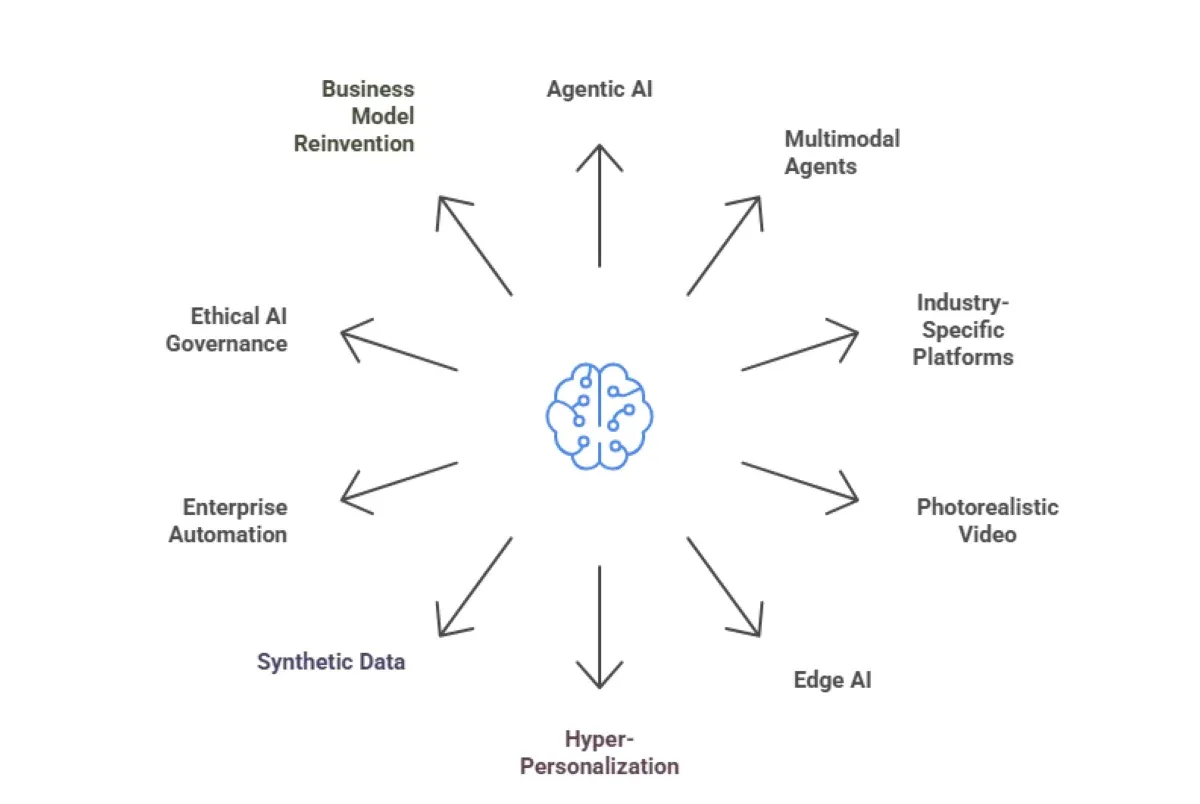
Generative AI is reshaping enterprise operations and business models at unparalleled speed. These ten transformations will define competitive advantage through 2026, fundamentally altering how organizations create value, serve customers, and drive innovation.
The AI you interact with today waits for your next prompt. The AI arriving by 2026 plans ahead, executes multi-step tasks, and makes decisions without you. This shift from reactive tools to proactive agents fundamentally changes how work gets done.
Instead of answering single questions, agentic AI systems plan and complete entire projects, like booking complex travel itineraries, coordinating vendor negotiations, or managing product launches from start to finish without constant supervision.
These systems learn from every interaction and outcome, continuously refining their approach based on what worked and what didn't, becoming more effective over time without manual retraining or reprogramming.
Multiple AI agents from different platforms will coordinate with each other, exchanging information and delegating subtasks to create seamless workflows that span across your entire software ecosystem without human mediation.
Your AI tools currently specialize; one handles text, another images, and a third does video. By 2026, that fragmentation ends as multimodal agents understand and generate across all formats simultaneously, processing the world the way humans do.
Submit a text script, reference images, and audio samples, and receive a fully edited video with synchronized visuals, soundtrack, and effects, all from a single prompt to one integrated system.
These systems connect concepts across different sensory inputs, understanding that a barking sound relates to a dog image, which relates to the word "canine," creating more contextually accurate and coherent outputs.
Developers treat all data types, like text, image, audio, and video, as interchangeable inputs and outputs within one framework, dramatically reducing complexity and accelerating time from concept to production for complex applications.
Generic AI tools force you to adapt your processes to their limitations. Domain-tailored platforms flip that equation, offering generative AI trained on industry-specific data, regulations, and workflows from day one.
Healthcare platforms understand HIPAA requirements, financial services platforms incorporate SEC regulations, and manufacturing systems align with ISO standards, reducing legal risk and accelerating deployment timelines without custom compliance engineering.
These platforms speak your industry's language fluently, understanding technical jargon, standard operating procedures, and common scenarios without extensive prompt engineering or explanation of basic domain concepts.
Instead of starting from scratch, you deploy models already trained on relevant medical literature, financial documents, or engineering specifications, delivering accurate, contextually appropriate outputs immediately without expensive fine-tuning.

Today's AI-generated videos still reveal their artificial origins through inconsistent physics, temporal glitches, and duration limits. By 2026, those telltale signs will disappear as generative video achieves true photorealistic quality at scale.
Small teams produce television-quality commercials, training videos, and product demonstrations that match Hollywood production values, complete with consistent lighting, realistic physics, and seamless motion at a fraction of traditional costs.
Move beyond 10-second clips to generating complete presentations, educational courses, or marketing campaigns with temporal coherence maintained across minutes or hours, not just seconds, enabling genuine business applications.
Marketing teams, training departments, and small businesses create professional-grade visual content without film crews, studios, or specialized equipment. Lowering barriers to high-quality communication and dramatically expanding creative possibilities.
Cloud-based AI introduces latency, connectivity dependencies, and privacy risks. Edge deployment brings generative AI directly to devices, vehicles, and infrastructure, where decisions happen in milliseconds and data stays local.
Factory floor systems analyze products, detect defects, generate inspection reports, and adjust production parameters instantly without sending visual data to external servers, maintaining speed, security, and immediate corrective action.
Smart buildings, traffic systems, and utility grids use on-device generative AI to predict failures, optimize operations, and respond to changing conditions in real-time without cloud latency or connectivity interruptions.
Sensitive data from surveillance cameras, medical devices, or financial terminals gets processed locally on edge hardware, generating insights and actions without transmitting raw information across networks or storing it externally.
Mass personalization has meant segmenting audiences into groups. Generative AI enables true individual-level customization, creating unique experiences, content, and recommendations for each person based on their specific context and behavior.
Marketing messages, product recommendations, and user interfaces dynamically adjust based not just on history, but on current mood, immediate context, and real-time behavior, responding to how someone feels today.
Each customer receives genuinely unique configurations, recommendations, and support experiences tailored to their specific use case, expertise level, and goals, not filtered through predetermined segments or personas.
Systems understand when you're in a hurry, when you're exploring options, or when you need detailed information, adjusting their communication style, depth, and format accordingly without explicit instruction.
Training sophisticated AI models requires massive, diverse, labeled datasets, which are expensive to collect and often restricted by privacy regulations. Synthetic data solves both problems by generating statistically accurate information without exposing real individuals or proprietary details.
Train fraud detection systems using synthetic financial transactions, develop healthcare AI with generated patient records, or build autonomous vehicle systems using simulated driving scenarios, all without accessing sensitive real-world data.
Generate unlimited examples of rare events, edge cases, or scenarios that haven't occurred yet, creating balanced training datasets that improve model performance on situations underrepresented in historical records.
Test new pharmaceutical compounds, financial strategies, or manufacturing processes through AI-generated simulations that mirror real-world complexity, reducing physical testing costs and accelerating innovation cycles.
Generative AI moves beyond assisting developers to autonomously handling entire workflows, from writing production code to making operational decisions that previously required human judgment and domain expertise.
AI systems write, test, debug, and deploy complete applications or features, not just code snippets, handling architecture decisions, error handling, and optimization while adhering to your organization's standards.
Infrastructure management, deployment pipelines, monitoring, and incident response become largely autonomous, with AI systems predicting failures, implementing fixes, and optimizing resource allocation without manual intervention.
Beyond rule-based systems, AI makes nuanced decisions in fraud detection, supply chain routing, maintenance scheduling, or customer prioritization by understanding context, balancing tradeoffs, and explaining its reasoning.
Training AI on copyrighted content without permission has sparked lawsuits and legislative action. By 2026, this legal uncertainty will be resolved through new licensing frameworks, compensation models, and technical solutions that protect both creators and innovation.
New marketplace structures emerge where content creators license their work for AI training, receive ongoing royalties from AI-generated outputs, and maintain control over how their intellectual property gets used.
Technical standards for watermarking AI-generated content, tracking data lineage, and verifying authenticity become mandatory, allowing organizations to prove content origins and maintain accountability throughout the creation chain.
Clear legal standards define fair use in AI contexts, establish liability for AI-generated outputs, and create enforcement mechanisms, reducing legal uncertainty that currently slows enterprise adoption and investment.
Generative AI isn't just improving existing processes; it's creating entirely new product categories, revenue streams, and business models that weren't economically viable before. Companies that recognize this early gain structural advantages.
New products emerge where AI generation is the core offering, not a feature, personalized education platforms, on-demand content services, or custom software generation, creating markets that didn't exist previously.
Companies transition from selling discrete products to offering continuous AI-powered services, generating recurring revenue through platforms that improve over time and deepen customer dependency and value.
Generative search fundamentally changes how customers find products and information, forcing businesses to rethink SEO, advertising, and content strategies as AI summaries replace traditional click-through traffic and conversion funnels.
The organizations that thrive through these transformations start preparing today, not when their competitors have already deployed. This roadmap provides concrete steps you can take now to position yourself for 2026's opportunities.
Assess your data infrastructure, technical capabilities, team skills, and existing AI initiatives to identify gaps between the current state and where you need to be for next-generation applications.
Select two or three high-impact use cases aligned with these transformations, run time-boxed pilots with clear success metrics, and learn quickly what works in your specific context.
Create clear policies around data usage, model deployment, content attribution, and decision authority before regulatory requirements force rushed implementations that constrain flexibility and innovation.
Build internal capabilities through targeted hiring and training while partnering with specialized providers like Folio3 AI for expertise in deployment, integration, and domain-specific applications.
Redesign roles, workflows, and incentive structures to accommodate AI augmentation rather than forcing new tools into old processes. The technology is ready, but organizational adaptation determines success.
As a trusted generative AI development partner, we provide comprehensive solutions that empower enterprises to drive innovation, streamline operations, and deliver tangible business results. From initial strategy through full deployment, our scalable generative AI consulting and technology services help organizations achieve new heights of efficiency and sustainable growth.
We create bespoke generative AI models, precisely calibrated to your datasets, industry requirements, and specific use cases. Whether working with text, imagery, or intricate data structures, our models ensure precision, scalability, and measurable business value aligned with your goals.
We integrate generative AI capabilities directly into your current IT infrastructure. From CRM and ERP platforms to custom-built systems, we deliver frictionless implementation that preserves existing workflows while enhancing operational productivity and accelerating return on investment.
Our specialists develop refined prompts customized for your enterprise systems, guaranteeing dependable, contextually appropriate, and superior AI responses. The outcome: enhanced model effectiveness and trustworthy outputs that consistently meet your organizational requirements.
Enhance your in-house capabilities with our experienced MLOps professionals. We bolster your generative AI infrastructure through expert management of model launches, continuous monitoring, performance scaling, and routine optimization, ensuring your AI solutions remain consistently operational and effective.
We streamline repetitive development tasks through AI-powered automation tools, shortening software delivery timelines, minimizing manual workload, and maintaining superior code standards. This approach allows your development teams to concentrate on strategic, high-impact projects that fuel business advancement.

{ "@context": "https://schema.org", "@type": "FAQPage", "mainEntity": [ { "@type": "Question", "name": "What is generative AI and why is 2026 a critical milestone?", "acceptedAnswer": { "@type": "Answer", "text": "Generative AI creates new content such as text, images, video, and code, rather than only analyzing data. The year 2026 marks the shift from experimental AI tools to enterprise-grade production systems, with regulations, business models, and technical capabilities maturing simultaneously." } }, { "@type": "Question", "name": "Which industries will see the biggest generative AI transformations by 2026?", "acceptedAnswer": { "@type": "Answer", "text": "Healthcare, financial services, manufacturing, media and entertainment, and software development will experience the largest transformations due to high data volumes, regulatory complexity, and major economic incentives driving rapid AI adoption." } }, { "@type": "Question", "name": "How will generative AI change business models and revenue streams?", "acceptedAnswer": { "@type": "Answer", "text": "Generative AI will enable AI-native products and subscription services, enhance traditional products with AI features, and help companies monetize data and domain expertise. Search and customer acquisition models will shift as AI summaries reduce click-through dependency." } }, { "@type": "Question", "name": "What does multimodal generative AI mean, and how will it impact enterprises?", "acceptedAnswer": { "@type": "Answer", "text": "Multimodal AI processes and generates text, images, audio, and video within a single system. This removes the need for multiple tools and complex integrations, simplifying workflows in marketing, training, customer service, and product development." } }, { "@type": "Question", "name": "Why is edge/IoT integration important for generative AI adoption?", "acceptedAnswer": { "@type": "Answer", "text": "Edge AI reduces latency, keeps data private by processing locally, and supports real-time decisions for manufacturing, infrastructure, and autonomous systems. It is essential for applications requiring millisecond responses and strict data security." } }, { "@type": "Question", "name": "How can companies prepare now (in 2025) to leverage generative AI in 2026?", "acceptedAnswer": { "@type": "Answer", "text": "Organizations should launch focused AI pilots, develop governance frameworks, invest in technical expertise and partnerships, and redesign workflows for AI augmentation. Organizational readiness is more challenging than technology deployment." } }, { "@type": "Question", "name": "What are the key governance, privacy, and regulatory considerations for generative AI in the US?", "acceptedAnswer": { "@type": "Answer", "text": "US enterprises must comply with emerging state-level AI regulations, industry-specific requirements, copyright and IP guidelines for training data, and privacy laws. Clear policies around deployment, attribution, and decision-making reduce legal and ethical risks." } }, { "@type": "Question", "name": "How does synthetic data support generative AI initiatives?", "acceptedAnswer": { "@type": "Answer", "text": "Synthetic data provides unlimited training samples without privacy concerns, overcomes scarcity of rare events, and enables testing in simulated environments. It accelerates AI development while reducing regulatory and security challenges." } }, { "@type": "Question", "name": "What role do talent and organizational structure play in generative AI transformation?", "acceptedAnswer": { "@type": "Answer", "text": "Organizational readiness determines AI success more than technical capability. New roles such as prompt engineers, model trainers, and AI coordinators are essential, requiring investment in upskilling and workflow redesign." } }, { "@type": "Question", "name": "Why should organizations choose Folio3 AI to navigate generative AI transformations?", "acceptedAnswer": { "@type": "Answer", "text": "Folio3 AI brings deep expertise in computer vision, large language models, and industry-specific AI applications, with a strong track record of delivering enterprise AI systems for Fortune 500 clients. Their end-to-end services combine technical capability with strategic guidance." } } ] }
Generative AI creates new content, like text, images, video, and code, rather than just analyzing existing data. 2026 represents the shift from experimental tools to production systems embedded across industries, with regulatory frameworks, business models, and technical capabilities reaching maturity simultaneously.
Healthcare, financial services, manufacturing, media and entertainment, and software development will experience the most dramatic shifts. These sectors combine high data volumes, regulatory complexity, and significant economic incentives that drive rapid adoption and innovation.
New AI-native products and subscription services will emerge, traditional products will add AI-powered features, and companies will monetize their data and domain expertise by fine-tuning industry-specific models. Search and customer acquisition models will fundamentally change as AI summaries replace click-through traffic.
Multimodal AI processes and generates multiple content types, like text, images, audio, and video, simultaneously within one system. This eliminates the need for separate tools and complex integration, dramatically simplifying workflows for marketing, training, customer service, and product development.
Edge deployment eliminates cloud latency, maintains data privacy by processing locally, and enables real-time decisions in manufacturing, infrastructure, and autonomous systems. This is critical for applications where milliseconds matter and sensitive data cannot leave the premises.
Start with focused pilots in high-value use cases, establish governance frameworks before they're mandated, invest in technical talent and partnerships, and most importantly, redesign organizational structures and workflows to accommodate AI augmentation. Technology deployment is easier than organizational change.
US companies must navigate emerging state-level AI regulations, industry-specific requirements, copyright and IP protection for training data, and data privacy laws. Clear policies around model deployment, content attribution, and decision authority reduce legal risk.
Synthetic data provides unlimited training examples without privacy risks or data collection costs, overcomes the scarcity of rare events or edge cases, and enables testing in simulated environments before real-world deployment. This accelerates development while reducing regulatory and security concerns.
Technical capabilities matter less than organizational readiness; how you restructure roles, redesign workflows, and retrain employees determines success. New roles like prompt engineers, model trainers, and AI coordinators become critical, requiring significant investment in reskilling and change management.
Folio3 AI brings deep expertise across computer vision, LLMs, and industry-specific applications, with proven experience deploying enterprise AI systems for Fortune 500 clients. We combine technical capabilities with domain knowledge in finance, healthcare, manufacturing, and logistics, helping organizations move from strategy to production quickly.