
Loading...

To understand the MapReduce algorithm, it is vital to understand the challenge it attempts to provide a solution for. With the rise of the digital age and the capability of capturing and storing data, there has been an explosion in the amount of data at our disposal. Businesses and corporations were intuitive enough to realize the true potential of this data in terms of gaining insights about customer needs and making predictions to take informed decisions; yet, only within a few years, managing this gigantic amount of data posed a serious challenge for organizations. This is where Big Data comes into the picture.
Big data refers to the gigantic volumes of structured and unstructured data and the ways of dealing with it to aid in strategic business planning, reduction in production costs, and smart decision-making. However, with Big Data came great challenges of capturing, storing, analyzing and sharing this data with traditional database servers. As a major breakthrough in processing of immense data, Google came up with the MapReduce algorithm inspired by the classic technique: Divide and Conquer.
MapReduce, when combined with Hadoop Distributed File System, plays a crucial role in Big Data Analytics. It introduces a way of performing multiple operations on large volumes of data parallely in batch mode using ‘key-value’ pair as the basic unit of data for processing.
MapReduce algorithm involves two major components: Map and Reduce.
The Map component (aka Mapper) is responsible for splitting large data in equal-sized chunks of information, which are then distributed among several nodes (computers) in such a way that the load is balanced and distributed, as well as faults and failures are managed by rollbacks.
The Reduce component (aka Reducer) comes into play once the distributed computation is completed and acts as an accumulator to aggregate the results as final output.
Hadoop MapReduce is an implementation of MapReduce algorithm by Apache Hadoop project to run applications where data is processed in a parallel way, in batches, across multiple CPU nodes.
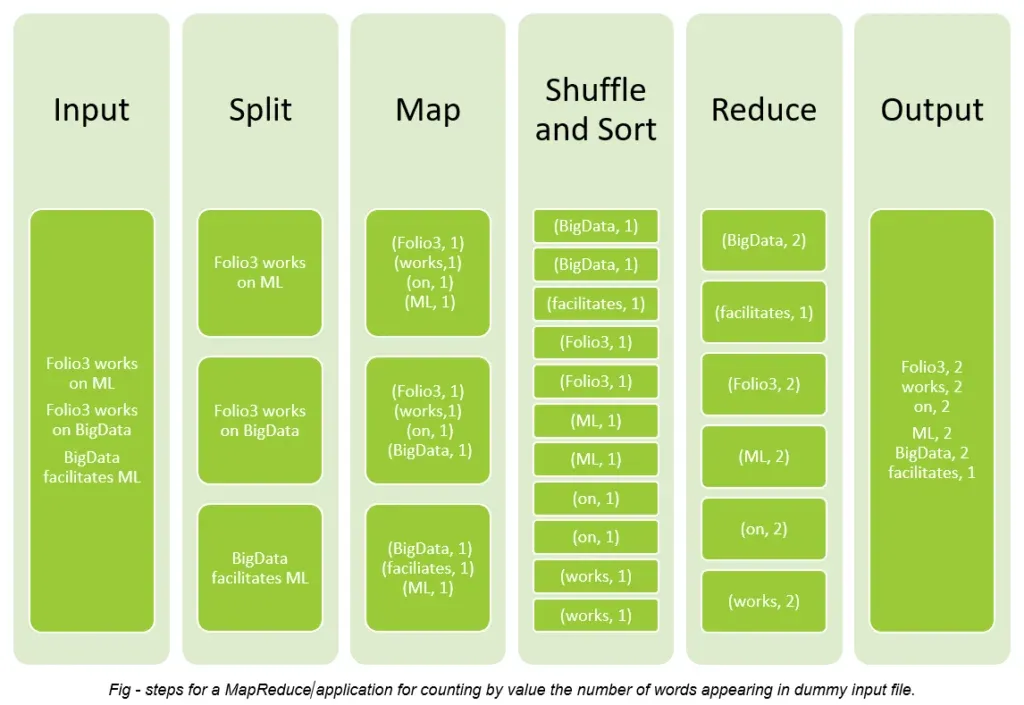
The entire process of MapReduce includes four stages.
In the first phase, the input file is located and transformed for processing by the Mapper. The file gets split up in fixed-sized chunks on Hadoop Distributed File System. The input file format decides how to split up the data using a function called InputSplit. The intuition behind splitting data is simply that the time taken to process a split is always smaller than the time to process the whole dataset as well as to balance the load eloquently across multiple nodes within the cluster.
Once all the data has been transformed into an acceptable form, each input split is passed to a distinct instance of the mapper to perform computations that result in key-value pairs of the dataset. All the nodes participating in the Hadoop cluster perform the same map computations on their respective local datasets simultaneously. Once mapping is completed, each node outputs a list of key-value pairs, which are written on the local disk of the respective node rather than HDFS. These outputs are now fed as inputs to the Reducer.
Before the reducer runs, the intermediate results of the mapper are gathered together in a Partitioner to be shuffled and sorted to prepare them for optimal processing by the reducer.
For each output, reduce is called to perform its task. The reduce function is user-defined. Reducer takes as input the intermediate shuffled output and aggregates all these results into the desired result set. The output of reduce stage is also a key-value pair, but can be transformed in accordance to application requirements by making use of OutputFormat, a feature provided by Hadoop.
It is clear from the stages’ order that MapReduce is a sequential algorithm. Reducer cannot start its operation unless Mapper has completed its execution. Despite being prone to I/O latency and a sequential algorithm, MapReduce is thought of as the heart of Big Data Analytics owing to its capability of parallelism and fault-tolerance.
After getting familiar with the gist of the MapReduce Algorithm, we will now move ahead to translate the Word Count Example as shown in the figure into Python code.
We aim to write a simple MapReduce program for Hadoop in Python that is meant to count words by value in a given input file.
We will make use of Hadoop Streaming API to be able to pass data between different phases of MapReduce through STDIN (Standard Input) and STDOUT (Standard Output).
Create a file named dummytext.txt with the following content:

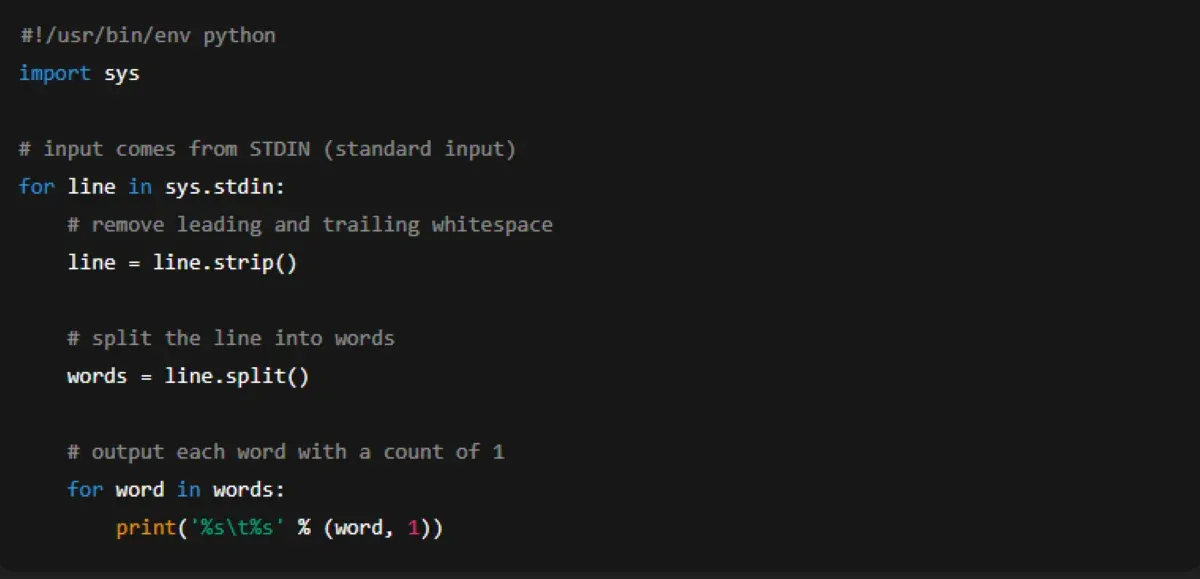
Create a file named mapper.py.
This script reads from STDIN and outputs key-value pairs (word, 1):
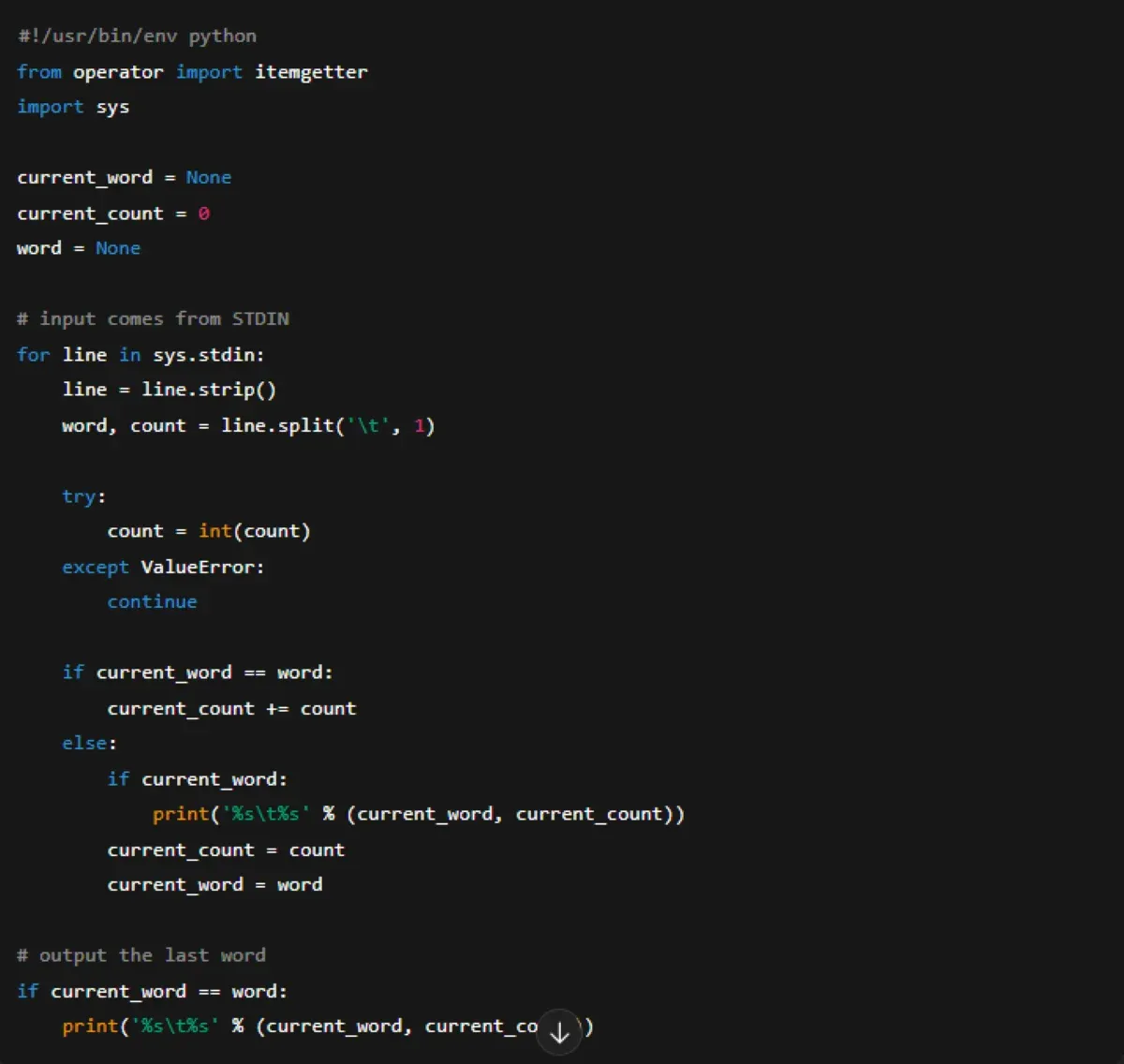
Create a file named reducer.py.
This script reads mapper output and sums up counts for each word:
Run the following commands:

5. Run MapReduce Locally
You can test the job on your local machine with:

We assume Hadoop user = f3user.


The job will read input from:
The job will read input from:/user/f3user/dummytext.txt
And write results to:/user/f3user/wordcount

Running this job will produce the output as:
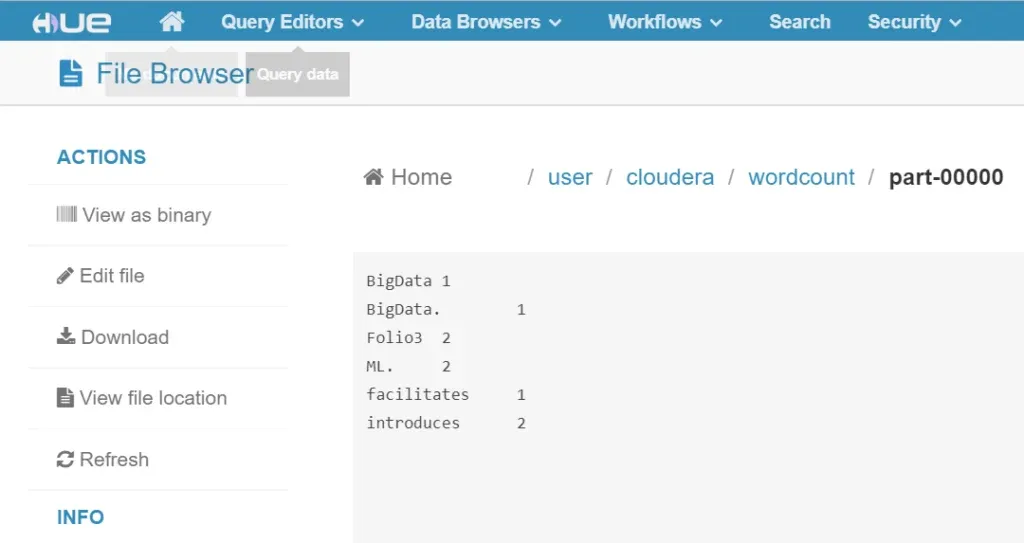
Congratulations, you just completed your first MapReduce application on Hadoop with Python!
MapReduce solves the problem of processing and analyzing massive datasets that cannot be handled by traditional databases or single servers. It distributes computations across multiple machines and aggregates results efficiently.
MapReduce is the core framework that powers Big Data analytics by enabling distributed, parallel processing. It allows organizations to transform raw data into actionable insights at scale.
The Mapper function breaks large datasets into key-value pairs for processing. The Reducer then collects, aggregates, and summarizes these pairs to produce final meaningful results.
Hadoop provides the HDFS (Hadoop Distributed File System) for storing massive datasets and the MapReduce engine for distributed computation. This combination makes data processing scalable, reliable, and fault-tolerant.
The stages are Input Split, Mapping, Shuffling & Sorting, and Reducing. Together, they ensure efficient data division, parallel processing, and final aggregation into usable insights.
Hadoop Streaming allows developers to use custom scripts (Python, Perl, etc.) as mappers and reducers. It passes data through STDIN and STDOUT, making Hadoop flexible beyond Java-based implementations.
You can test locally by piping input through mapper and reducer scripts using the command line. For example:
cat input.txt | python mapper.py | sort -k1 | python reducer.py This simulates Hadoop’s behavior on a small dataset.
InputSplit defines how input data is divided into manageable chunks for processing by mappers. This ensures each node gets an equal share of work and speeds up computation.
MapReduce is widely used for word count, log analysis, indexing, data summarization, and IoT data processing. It is a flexible framework for transforming unstructured data into structured insights.
Folio3 provides expertise in Big Data, Deep Learning, NLP, and Computer Vision. We help businesses design, implement, and optimize custom MapReduce and Hadoop-based solutions for analytics, automation, and decision-making.
Please feel free to reach out to us, if you have any questions. In case you need any help with development, installation, integration, up-gradation and customization for your Business Solutions.
We have expertise in Deep learning, Computer Vision, Predictive learning, CNN, HOG and NLP.
Connect with us for more information at Contact@folio3.ai