
Loading...
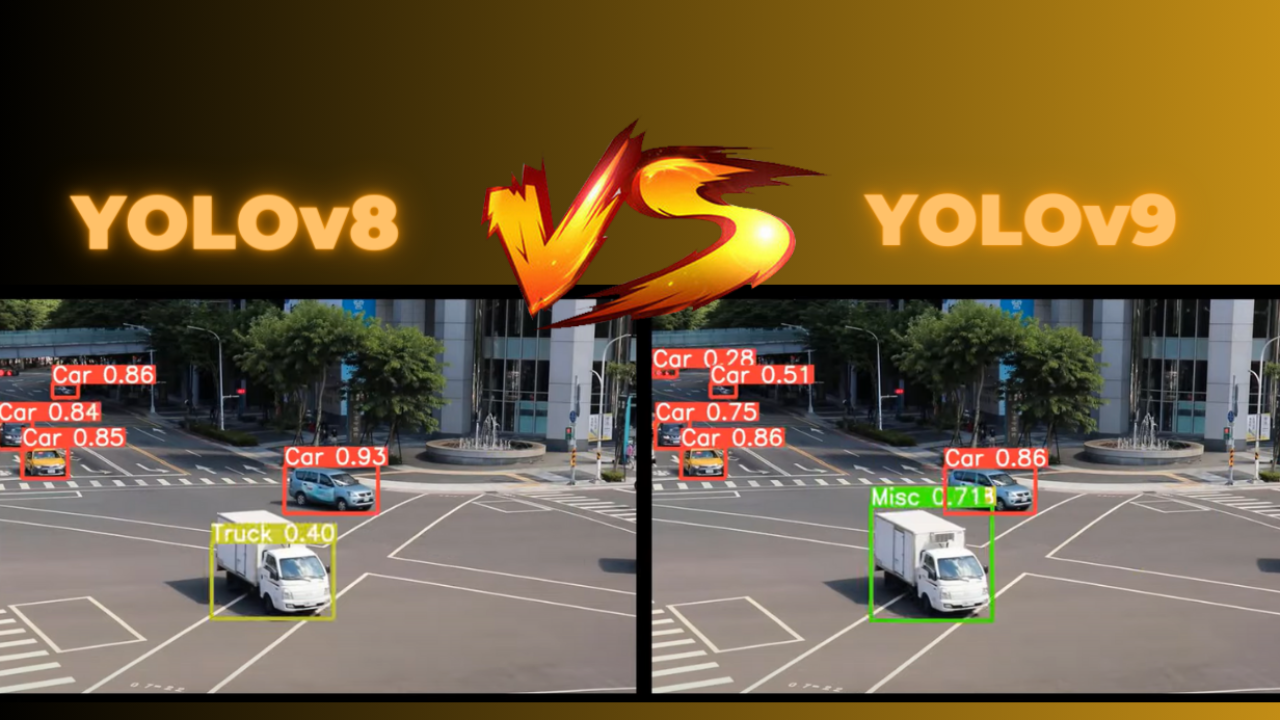
The dynamic evolution of object detection algorithms reaches a pinnacle with the inception of YOLOv9, a groundbreaking iteration designed to surpass its predecessors in both performance and accuracy. This comprehensive analysis delves into the technical intricacies of YOLOv9, elucidating its architectural innovations and performance enhancements that distinguish it from YOLOv8. By unraveling the core advancements, this article aims to provide a holistic understanding of why YOLOv9 emerges as the undisputed champion in object detection. In this article we will discuss comparison between YOLOv9 vs YOLOv8.
YOLOv9 emerges as a cutting-edge model, boasting innovative features that will play an important role in the further development of object detection, image segmentation, and classification. The new top-tier features allow faster, sharper, and more versatile actions.

Programmable Gradient Information (PGI): PGI is a key innovation in YOLOv9, addressing the challenges of information loss inherent in deep neural networks. By integrating PGI, YOLOv9 enhances its learning capacity and ensures the retention of crucial information throughout the detection process, thereby achieving exceptional accuracy and performance. PGI allows for the generation of reliable gradients through an auxiliary reversible branch, ensuring that deep features retain crucial characteristics necessary for executing target tasks. This addresses the issue of information loss during the feedforward process in deep neural networks.
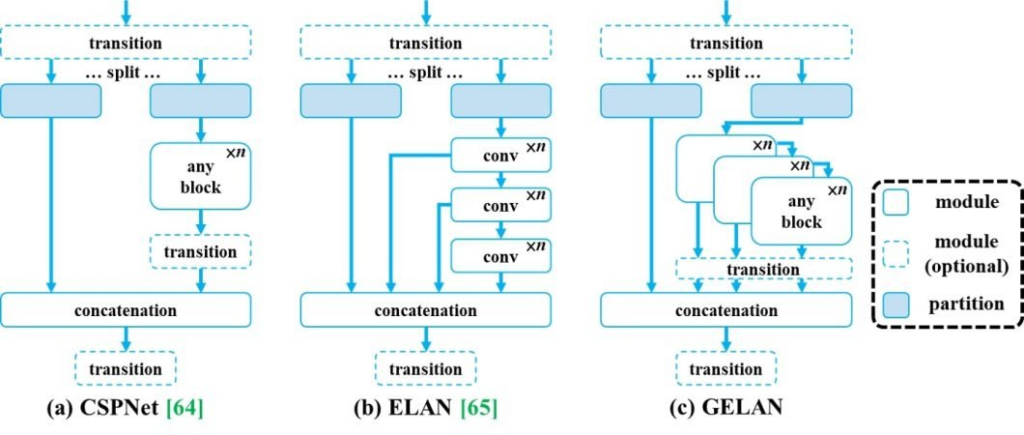
Generalized Efficient Layer Aggregation Network (GELAN): GELAN is another pivotal component of YOLOv9, designed to optimize parameters, computational complexity, accuracy, and inference speed. By allowing users to select appropriate computational blocks for different inference devices, GELAN enhances the flexibility and efficiency of YOLOv9. This architecture exclusively employs conventional convolution operators, achieving superior parameter utilization compared to state-of-the-art methods that rely on depthwise convolution.
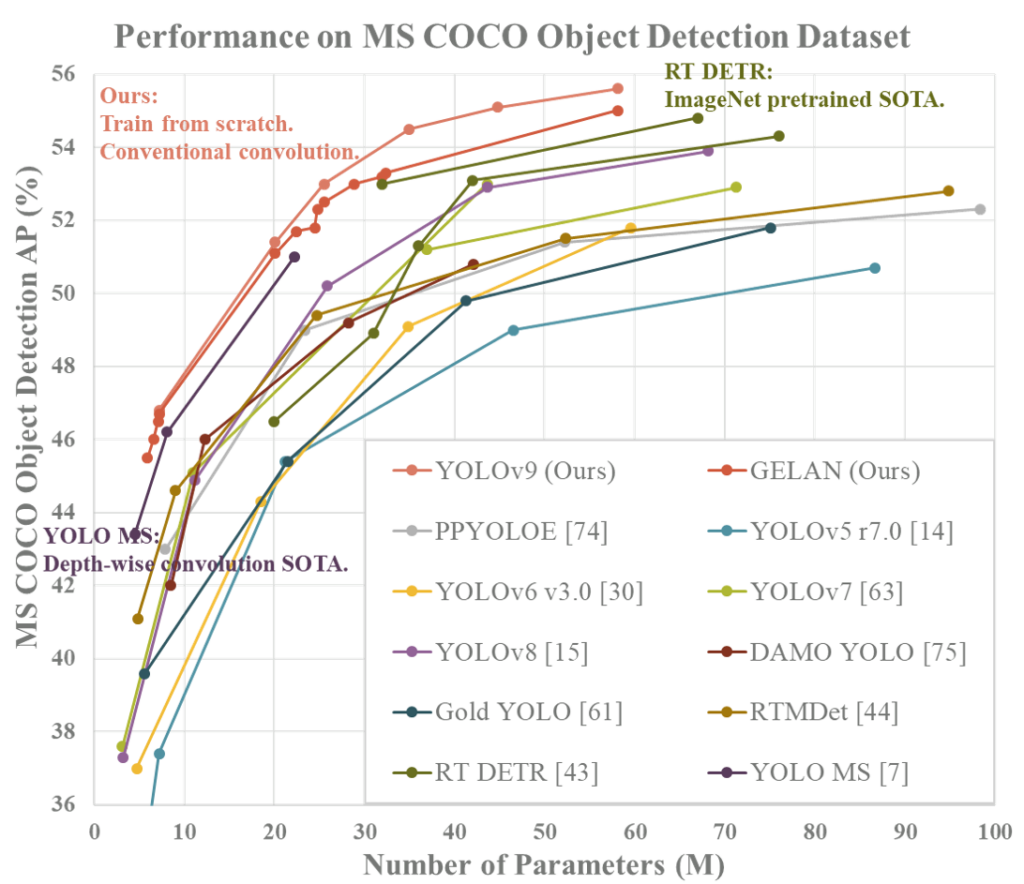
Performance Enhancements and Technical Insights: key improvement in YOLO v9 over its predecessor is its significant reduction in the model's size and computational demands, with a 49% reduction in parameters and a 43% reduction in calculations compared to YOLO v8. Despite this downsizing, YOLO v9 manages to improve its Average Precision (AP) on the MS COCO dataset by 0.6%, showcasing its enhanced efficiency and effectiveness in object detection tasks.The performance metrics of the models vary, with the smallest model achieving a 46.8% AP and the largest model achieving a 55.6% AP on the MS COCO dataset validation set. This variation allows users to choose a model that best suits their performance versus computational resource balance.
1. What is YOLO in the context of AI and computer vision? YOLO (You Only Look Once) is a state-of-the-art, real-time object detection algorithm known for its speed and accuracy. It can detect and classify multiple objects within an image in one evaluation. 2. How does YOLOv9 or YOLOv8 enhance ALPR systems? YOLOv9 or YOLOv8 enhances the ALPR system by providing rapid and accurate detection of license plates from video or image data, making the overall process more efficient and reliable. 3. What is the main difference between YOLOv9 and YOLOv8? YOLOv9 introduces further improvements in speed, accuracy, and computational efficiency over YOLOv8. While YOLOv8 already enhanced these aspects from its predecessors, YOLOv9 builds on this foundation with more advanced algorithms and optimizations. 4. How does the architecture of YOLOv9 differ from YOLOv8? YOLOv9 incorporates a more refined architecture that includes improved network layers, better feature extraction techniques, and enhanced data augmentation methods. These changes aim to boost performance metrics such as precision and recall.